AI Trends in Translation QA for Software Teams
August 23, 2026
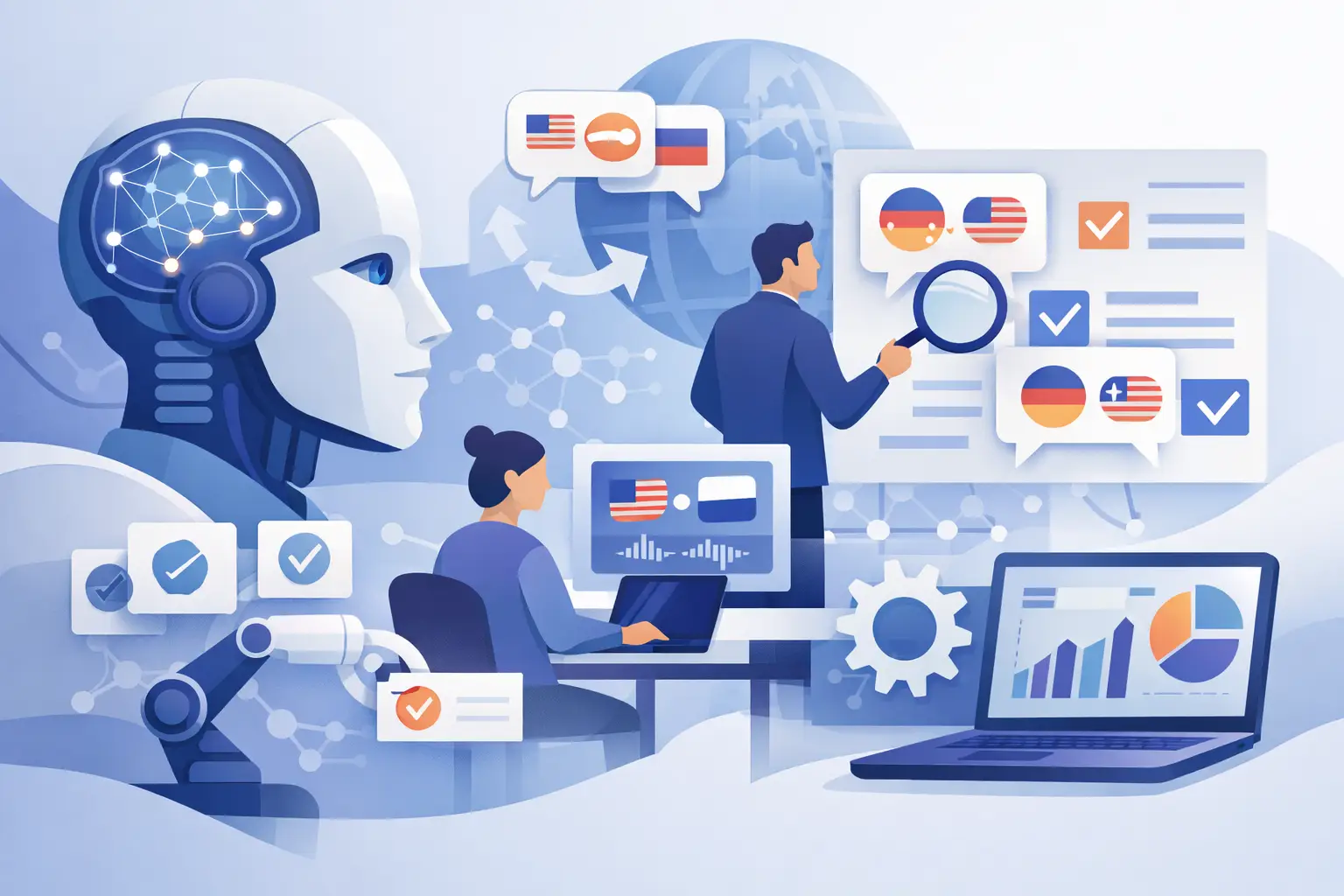
A missing placeholder can break a checkout flow in one locale. A translated button that grows by 40 percent can hide behind an icon. A terminology mismatch can make a regulated feature look like a different product. These are the defects that make AI trends in translation QA relevant to software teams: not because AI replaces quality assurance, but because release-scale localization creates more signals than reviewers can inspect manually.
For technical localization, the useful question is not whether AI can judge a translation in the abstract. It is whether AI can help identify the strings, files, screens, and locale-specific changes that need attention before a build reaches production. The strongest implementations combine AI-assisted analysis with deterministic validation, terminology controls, visual review, and a workflow that keeps source files under the organization’s control.
AI is moving QA from sampling to risk-based review
Traditional translation QA often depends on sampling. Reviewers inspect a portion of translated strings, focus on visible screens, and react to issues found late in testing. That model becomes fragile when a product has frequent releases, dozens of locales, shared resource files, and content that changes across UI, documentation, email templates, and structured data.
AI changes the economics of review by ranking risk. Instead of treating every changed segment as equally likely to fail, an AI-assisted QA process can flag translations that differ materially from similar approved segments, use terminology inconsistently, omit variables, or appear semantically misaligned with their source. The reviewer spends time where the probability and impact of a defect are highest.
This does not mean every low-risk segment should pass without controls. File syntax, resource keys, plural rules, markup balance, accelerators, and placeholders still require deterministic checks. AI is most effective as a prioritization layer above these rules. It helps a team answer: what deserves human judgment first?
Confidence scores need context
A machine-generated confidence score is not a release decision. A short UI label such as “Save” may have high linguistic confidence but still be wrong if it refers to saving a draft rather than preserving a setting. Similarly, a string with low confidence may be perfectly acceptable because the product uses deliberate, domain-specific language.
Useful QA systems make confidence explainable. They show the source, translation, relevant translation memory matches, termbase entries, neighboring strings, and the reason for a warning. A reviewer can then accept, edit, or suppress the finding with an audit trail. Without context, confidence scoring becomes another queue that localization managers must manually interpret.
Terminology enforcement is becoming more adaptive
Termbases have always mattered in product localization, especially for technical, medical, financial, and enterprise software. The shift is that AI can now recognize more variations around a term than exact-match rules alone. It can detect when an approved product feature name was translated as a generic phrase, when a prohibited legacy term reappears, or when a related grammatical form should be reviewed.
The trade-off is precision. Overly aggressive semantic matching can flag valid language variations and frustrate translators. A German compound, Japanese product convention, or localized phrase may not resemble the preferred English term at surface level. Teams should configure terminology QA by severity: block prohibited terms and required brand names, warn on likely variants, and route ambiguous cases to reviewers.
This approach is especially useful when product terminology changes during a release cycle. AI can help locate the affected translations across multiple file types, but the authoritative terminology record still needs ownership. Someone must define the approved term, the locale-specific instruction, exceptions, and effective date.
Visual QA is gaining better triage, not becoming optional
Linguistic correctness does not guarantee a usable localized interface. Text expansion, truncated labels, hard-coded concatenation, right-to-left layout defects, and untranslated imagery only appear in context. For desktop, web, and mobile products, visual QA remains a separate and necessary discipline.
The emerging role of AI is to make visual inspection more targeted. Image analysis can compare localized screens with baseline layouts, detect probable overflow or clipping, identify untranslated text embedded in graphics, and surface screens that changed after a resource update. That reduces the effort required to find likely defects across large test matrices.
It cannot reliably decide whether a line break is acceptable, whether the hierarchy feels natural in a target market, or whether a shortened label creates ambiguity. Those are product and language decisions. A practical workflow uses automated screenshots or UI captures to identify candidates, then gives a linguist or product reviewer the visual editor and contextual metadata needed to resolve the issue.
Translation QA is moving closer to the build pipeline
The most consequential AI trend is operational rather than linguistic: QA is shifting left into continuous localization. Waiting for a final handoff creates large batches, delayed feedback, and expensive rework. Running checks when strings are scanned, translated, imported, or built catches errors when the responsible change is still easy to identify.
For development teams, this requires file-aware automation. A QA process must understand resource formats rather than treat content as plain text. JSON, RESX, PO, XLIFF, Android XML, iOS strings, YAML, HTML, Markdown, database exports, and proprietary resource formats have different rules for escaping, comments, placeholders, pluralization, and metadata. An apparently valid translation can still make an output file invalid or cause a runtime failure.
Build-time validation should therefore combine structural checks with linguistic checks. Confirm that keys are complete, tags are balanced, variables are preserved, encoding is correct, and locale files can be generated. Then apply translation memory, termbase, AI-assisted anomaly detection, and configured quality rules. The result should be deployable output, not a separate QA report that engineers must reconcile by hand.
Soluling supports this model by scanning source content locally, managing translation and validation in a unified workspace, and generating localized resources as part of an automated workflow. For organizations with repository, security, or compliance constraints, local and build-server execution also reduces the need to send source code or product files to disconnected services.
Retrieval is improving AI-assisted review
Generic language models are weak reviewers when they lack product context. The same source sentence can require different translations depending on the screen, user role, feature state, and established terminology. The most useful systems ground AI suggestions and QA findings in controlled project data.
That data includes approved translations from translation memory, current terminology, translator instructions, resource comments, UI context, and previous review decisions. When AI retrieves relevant examples before evaluating a segment, its feedback becomes more consistent with the product rather than merely plausible in the target language.
There is a governance requirement here. Translation memory often contains obsolete wording, customer-specific terminology, and past mistakes that were never corrected. Teams should treat retrieval sources as QA assets: maintain them, separate projects where necessary, and retire unreliable entries. Better retrieval does not compensate for poor reference data.
Human review is becoming more specialized
AI does not remove the need for reviewers. It changes where expert effort delivers the most value. Linguists increasingly handle ambiguity, tone, market appropriateness, terminology exceptions, and high-impact workflow strings. Engineers focus on format integrity, integration failures, and UI behavior. Localization managers define quality thresholds, escalation paths, and acceptance criteria by content type.
Those criteria should not be identical everywhere. A legal consent screen, a payment error message, and a marketing headline require different levels of review. So do a newly launched locale and a mature locale with stable translation memory. Risk-based QA works only when the team explicitly defines what risk means for each product area.
How to adopt AI-assisted translation QA without weakening controls
Start with a baseline. Measure the defects currently found after translation import, during functional testing, and after release. Categorize them: terminology, placeholders, markup, incomplete translations, visual defects, linguistic errors, or incorrect context. This shows where automation can produce an immediate result and where workflow design is the real issue.
Next, keep deterministic checks as release gates. AI findings can prioritize and enrich review, but they should not silently override rules for missing keys, broken syntax, invalid tags, or protected variables. Establish a review queue with clear severity levels, then monitor false positives and missed issues over several releases.
Finally, evaluate AI QA against production outcomes, not demo quality. A useful system reduces escaped defects, reviewer time, and release delays while preserving traceability. If it creates unexplained warnings or requires files to move through unmanaged external services, its apparent productivity gain may not survive contact with an enterprise release process.
The practical destination is not fully automated translation approval. It is a localization pipeline where every build carries better evidence: files are valid, terminology is controlled, risky changes are visible, and human reviewers can spend their expertise on the decisions that shape the product experience in each language.