Best Localization Workflow Practices for Software Teams
July 20, 2026
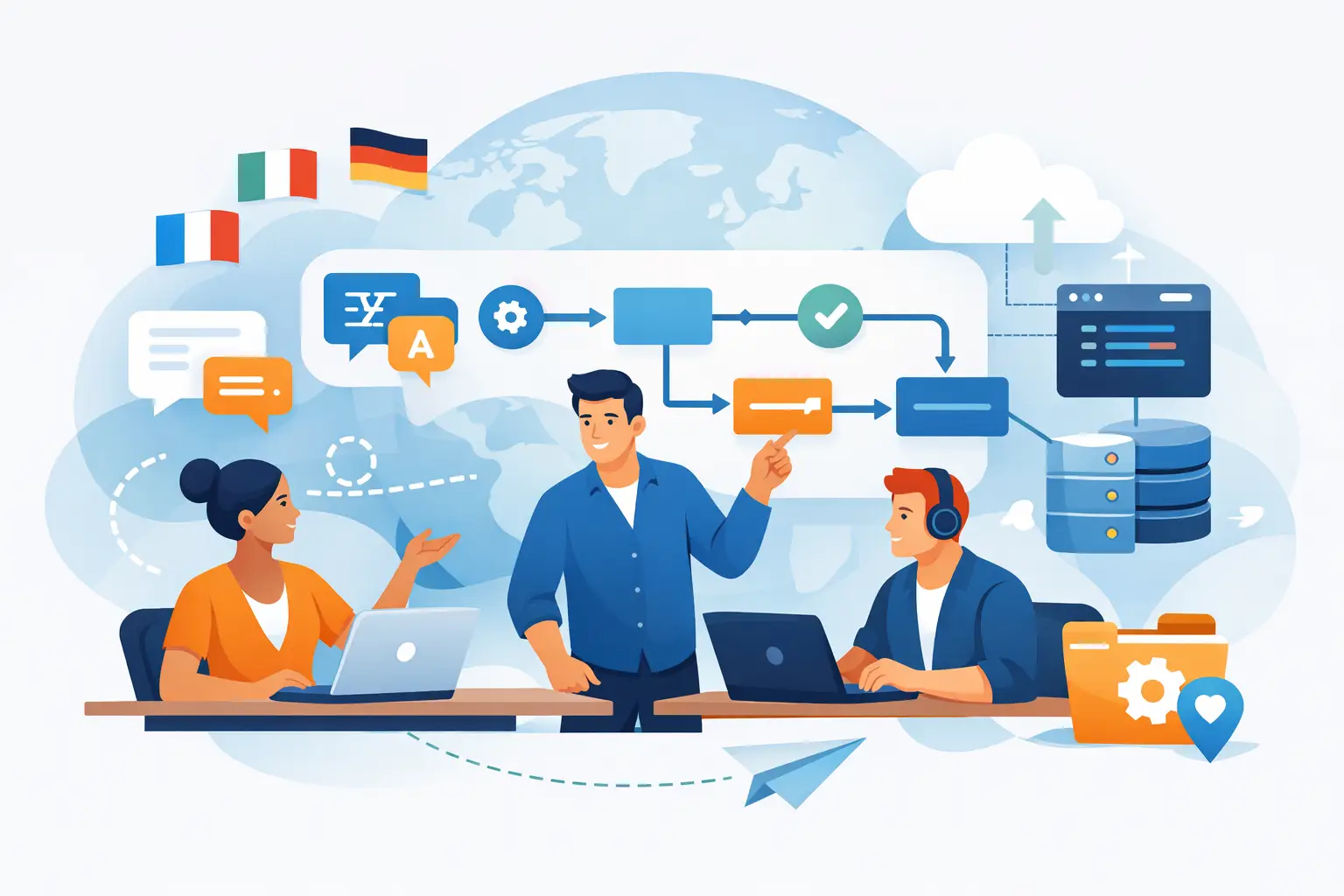
A release can compile successfully, pass automated tests, and still fail for international users because a button label is truncated, a plural rule is wrong, or a translator worked from an outdated string. The best localization workflow practices treat localization as an engineering process with controlled inputs, repeatable transformations, and verifiable outputs - not as a spreadsheet handoff near the end of a release.
For software teams, the practical goal is straightforward: every source change that affects localizable content should be detected, translated with the right context, validated in the target format, and made available to the build without creating a parallel, unmanaged release process. The details vary by application architecture and release cadence, but the workflow must preserve both linguistic quality and software integrity.
Build localization into the development lifecycle
Localization starts when developers create localizable content, not when a product manager declares a feature complete. Strings, assets, documentation fragments, database values, and structured content should be identified as part of normal development work. If extraction begins only after a code freeze, translators receive incomplete files, engineering receives late questions, and every correction becomes a release risk.
Separate translatable text from executable code and define a consistent resource strategy for each supported platform. For example, a .NET desktop application may use RESX resources, a web application may use JSON or PO files, and mobile projects may use platform-specific resource bundles. The exact format matters less than maintaining a predictable source of truth and stable identifiers for every message.
Stable identifiers are especially valuable when source wording changes. A translation system can preserve prior work when it recognizes that a string has been edited rather than deleted and recreated. This reduces unnecessary retranslation while giving localization reviewers a clear signal that a translation may need revision.
Give every string meaningful context
A source sentence is rarely enough. “Open,” “Save,” and “Close” can be verbs, labels, statuses, or commands. A translator who sees only isolated text must guess, and those guesses often appear as inconsistent terminology or incorrect grammar in the product.
Provide context at extraction time where possible: resource comments, feature names, UI locations, character limits, screenshots, and placeholder descriptions. Explain whether `{0}` is a customer name, whether `%d` is a quantity, and whether a phrase is used in a menu or confirmation dialog. This is not documentation overhead. It prevents defects that are expensive to detect after a localized build reaches QA.
Avoid concatenated strings such as `"Welcome " + userName`. Languages reorder phrases differently, and punctuation or grammatical gender may depend on the inserted value. Use complete message patterns with named placeholders and locale-aware formatting for dates, numbers, currency, and plurals.
Make source scanning repeatable and traceable
Manual export is one of the most common causes of localization drift. Someone exports a file, sends it for translation, developers change the source, and the returned translation package no longer matches the release branch. The workflow may still look organized, but it has lost traceability.
Use a defined scan process that identifies new, changed, and removed localizable content directly from project files. The scan should understand each format rather than treating source files as generic text. Format-aware processing protects syntax, markup, keys, comments, placeholders, and metadata while exposing only translatable values to linguists.
Run scans locally or on a controlled build server when source-code handling requirements are strict. This model allows teams to keep repositories and proprietary assets inside their own environment while still automating translation preparation and delivery. It also gives engineering an auditable process: the same project configuration can be executed by a developer workstation, a CI agent, or a release pipeline.
Branch strategy requires an explicit decision. Teams with frequent releases may maintain separate localization streams for a stable release branch and the main development branch. Teams using longer waterfall cycles may scan after feature completion and lock content before translation begins. Neither model is automatically better. The critical point is that each translation package maps to a known source revision and target release.
Centralize translation assets without separating teams
Translation memory and terminology management should be shared infrastructure, not personal files maintained by individual linguists. A translation memory reduces repeated work and improves consistency across versions, products, and documentation. A termbase establishes approved names for features, product concepts, technical terms, and words that should remain untranslated.
Centralization does not mean translators should receive no flexibility. Translation memory matches must be reviewed according to match quality and context. A 100% text match may still be wrong if the feature changed meaning or the target UI has a different length limit. Terminology should guide decisions, but it needs an owner and a review process when product language evolves.
Machine translation can accelerate first-pass translation for suitable content, particularly repetitive UI text and lower-risk documentation. It should be applied with rules, not as an unreviewed replacement for localization expertise. Protect sensitive data, prevent unsupported markup from being sent to translation engines, and route machine-generated output through linguistic review when customer-facing quality matters.
A unified environment such as Soluling can combine translation memory, terminology, visual editing, machine translation, and format-specific processing, reducing the number of manual exchanges between engineering and localization teams. The operational benefit is not merely fewer tools. It is a single record of what was scanned, translated, validated, and generated for each language.
Validate before localized files reach the release build
Translation quality checks must cover more than spelling. A linguistically correct string can still break an application if it removes a placeholder, corrupts markup, exceeds a technical constraint, or uses an invalid accelerator key. Validation should occur as soon as translations are imported or edited, then again when deployable files are generated.
Automate structural quality checks
Automated validation should detect missing and extra placeholders, invalid markup, duplicate keys, empty translations, untranslated source text, invalid resource syntax, and inconsistent formatting. It should also flag strings that exceed configured maximum lengths or violate rules for file names, character sets, and platform resources.
Treat validation findings by severity. A malformed JSON file or missing placeholder should fail the pipeline because it can break runtime behavior. A potential length issue may generate a warning that requires visual review. This distinction prevents teams from ignoring a noisy QA report while ensuring true release blockers receive immediate attention.
Test visual context in real interfaces
Static validation cannot tell whether a German command is clipped in a narrow dialog or whether a right-to-left layout reverses the intended meaning of an icon and label. Build localized applications and inspect representative screens, including first-run flows, error states, settings pages, reports, and dynamic content.
Pseudo-localization is useful before translations are available. By expanding text, adding visible markers, and optionally simulating right-to-left behavior, it exposes hard-coded strings, fixed-width controls, and layout assumptions during development. It is not a substitute for language review, but it catches internationalization defects early enough for developers to fix them efficiently.
Generate deployment-ready outputs in CI
The final step should not be a person copying translated files into a release folder. Configure the build process to generate the exact target artifacts required by each platform: satellite assemblies, resource bundles, localized JSON, document outputs, database scripts, or other supported deliverables. Build automation ensures that the files tested by QA are the files shipped to users.
Keep generated localization outputs versioned or reproducibly generated from versioned inputs. Record the project configuration, source revision, translation package version, validation result, and build number. When a customer reports a language-specific issue, this evidence makes it possible to determine whether the defect originated in source extraction, translation, file generation, or the application itself.
Release gates should reflect business risk. A consumer application launching in ten new markets may require linguistic signoff, visual checks, and full regression testing for each priority locale. An internal tool with a minor update may use automated checks plus targeted review. The workflow should be strict where failure is costly and efficient where the risk is lower.
Measure the workflow, not just translation volume
Counting words translated does not reveal whether localization is helping releases move faster. Track operational measures such as time from source change to available translation, percentage of strings reused from translation memory, validation errors per release, untranslated strings found in QA, and late source changes after translation starts.
These measures reveal where work is waiting. High retranslation rates may indicate unstable identifiers. Frequent UI defects may show that visual context arrives too late. A growing number of manual exports often signals that the localization process is outside the delivery pipeline. Use the data to improve the handoffs, configuration, and testing rules rather than asking translators or developers to work harder.
The strongest localization workflows make language delivery predictable. When developers can change resources with confidence, localization teams can work from controlled context, and builds can produce validated outputs on demand, global releases stop being a separate project and become a normal capability of the product team.