Continuous Localization vs Manual Handoff
June 30, 2026
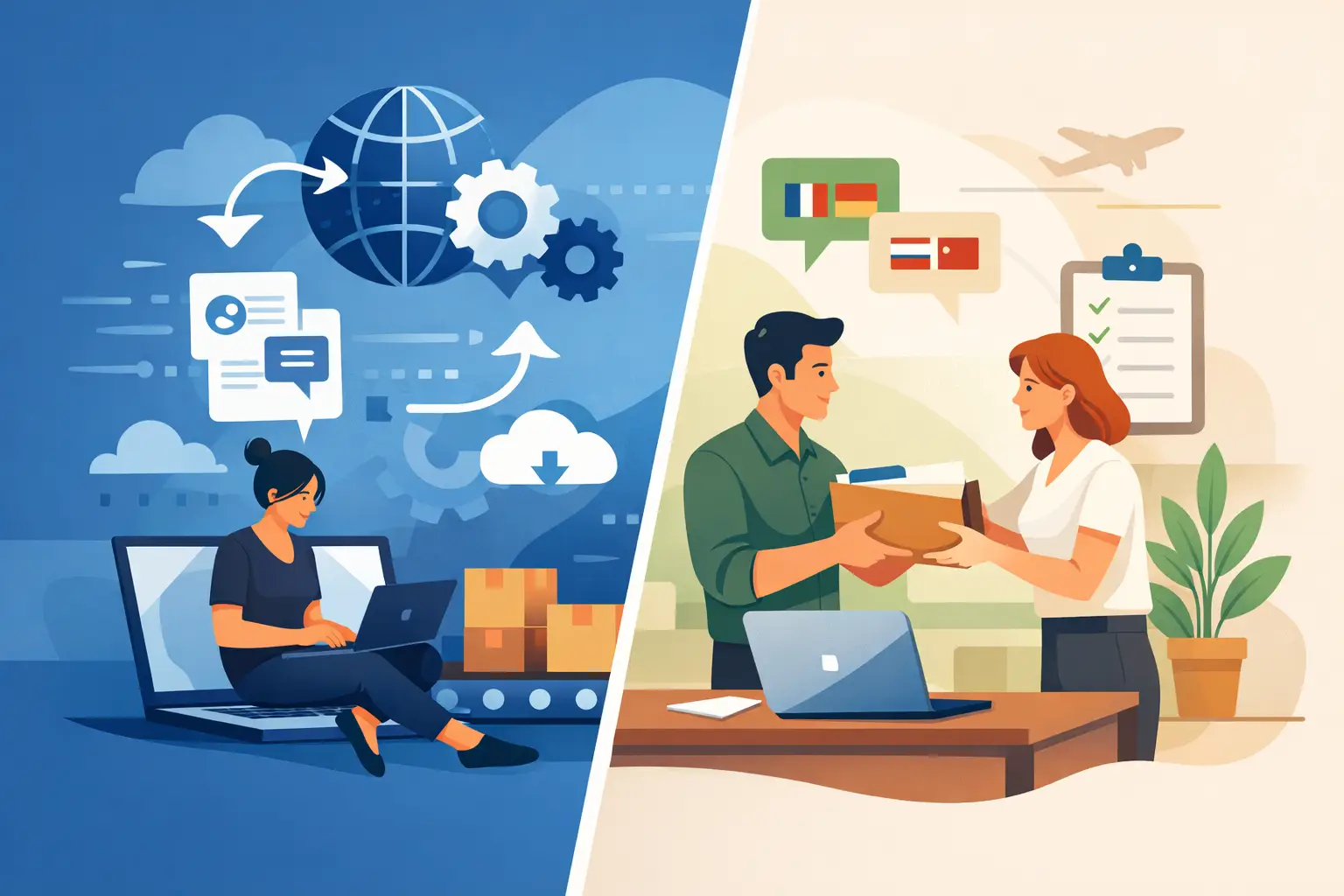
A release is ready, the code is frozen, and then someone asks for the latest strings in five languages. That moment captures the real difference in continuous localization vs manual handoff. One model treats translation as part of the build and release process. The other treats it as a separate task that starts after development has already moved on.
For engineering teams, this is not a philosophical choice. It affects branch strategy, QA coverage, release timing, rework, and how much confidence you have when shipping multilingual products. For localization managers, it changes how translation memory is reused, how terminology is enforced, and whether quality checks happen early or only after translated files come back.
What changes in continuous localization vs manual handoff
Manual handoff is the familiar workflow. Developers extract strings, package files, email or upload them, wait for translation, then import the results later. In a waterfall release model with infrequent updates, that can be workable. It is also easy to understand because each team has a clear turn.
The problem is that software rarely stands still long enough for that model to remain clean. Strings change after handoff. Branches diverge. Screens evolve. A translator works on text that no longer matches the UI, and engineering has to reconcile translated assets with newer source files. Even when everyone does careful work, the process itself introduces delay and drift.
Continuous localization moves localization upstream and keeps it there. Source changes are scanned automatically or on schedule, translatable content is updated in the localization environment, and translated outputs are generated back into build-ready files without a separate scramble at the end. Instead of batching language work around release dates, teams process changes as they happen.
That shift sounds procedural, but it changes the operational reality. Localization stops being a release blocker and becomes another managed stream in the delivery pipeline.
Speed is the obvious advantage, but not the only one
The first reason teams move away from manual handoff is speed. If strings are collected, assigned, translated, validated, and returned continuously, there is less idle time between development and release. Smaller change sets are also easier to review than large translation batches pushed through under deadline pressure.
But speed alone does not explain the full value. Continuous localization also reduces coordination overhead. Developers do not need to repeatedly prepare export packages, answer file-format questions, and merge returned translations by hand. Localization teams do not need to chase the current source version or wonder whether the spreadsheet they received is already outdated.
That matters most in products with frequent releases, multiple repositories, or a mix of app, web, document, and structured content. Every manual handoff adds another point where version mismatch can appear. Automation does not remove complexity from the product, but it does remove unnecessary complexity from the workflow.
Quality improves when context and validation move earlier
Manual handoff often weakens quality in subtle ways. Translators may receive flat string lists with limited context. Placeholder rules, resource keys, markup, plural forms, and length constraints can be missed until import time or even production. QA becomes reactive.
Continuous localization gives teams more chances to catch issues before they are expensive. When source files are scanned directly, the system can preserve structure, metadata, and context from the original format. Visual editors can show where text appears. Translation memory and terminology can be applied consistently across updates rather than reintroduced in disconnected batches. Validation can run while translations are created, not only after they return.
This is where technical localization platforms have a clear advantage over generic file exchange workflows. If the system understands the actual file formats and can generate deployment-ready outputs, it can validate syntax, placeholders, and resource integrity with much higher confidence than a spreadsheet-based process. That is especially important for software strings, JSON, XML, RESX, XLIFF, mobile resources, help content, and other structured assets where one small error can break a build.
Control and security are often the deciding factors
Some organizations still tolerate manual handoff because it feels controlled. Files are exported intentionally, reviewed, and sent to a known destination. In practice, that control is often superficial. Copies of source content spread across email threads, shared folders, and ad hoc vendor portals. Auditability becomes difficult. So does proving which source version was translated.
A well-designed continuous localization workflow can offer more control, not less. Local file scanning, on-premises execution, or build-server processing lets teams keep source code and repositories inside their own environment. Only the required translatable content moves through the localization process. That is a better fit for organizations with security, compliance, or IP protection requirements.
This is one reason developer-led companies prefer localization infrastructure that runs close to the build rather than as a disconnected service layer. The more complex the product and the stricter the governance, the more valuable that architectural choice becomes.
Manual handoff still has legitimate use cases
There is no need to pretend manual handoff is always wrong. It can still be the right fit when releases are infrequent, the product has a small amount of stable text, and the team does not have the volume to justify workflow automation. It can also work for one-time localization projects, legacy content, or highly controlled approval chains where change happens in large planned phases.
Some teams also use a hybrid model for practical reasons. Core application resources may move through continuous localization, while regulated documentation or marketing review cycles still follow a more traditional handoff process. That is not a failure of strategy. It reflects the fact that different content types carry different timing, ownership, and approval requirements.
The mistake is not choosing manual handoff. The mistake is keeping it after the team has outgrown it.
When the handoff model starts breaking down
The warning signs are usually operational, not theoretical. Releases slip because language files arrive late. Developers spend time merging translations instead of shipping features. Translators ask for updated source files mid-project. QA finds broken placeholders, missing strings, or untranslated UI right before release. Localization managers cannot get a clear picture of what changed between builds.
If that sounds familiar, the issue is rarely translator performance. It is usually process design.
Teams tend to hit the limit of manual handoff when they have continuous delivery or even just regular sprint-based releases, multiple product variants, shared string repositories, or more than a few target languages. At that point, each export and import cycle becomes a source of friction. The larger the product portfolio, the more that friction multiplies.
What implementation really requires
Moving to continuous localization is not just a switch from one export method to another. It requires decisions about source scanning, branching, translation assignment, automation triggers, QA rules, and output generation. Teams also need clarity on ownership. Engineering should not become accidental localization operations, and localization should not be forced to reverse-engineer build artifacts.
The best implementations are usually boring in the right way. Source files are detected automatically. New strings are decoupled and routed to translators with translation memory and termbase support. Validation runs early. Outputs are generated back into the exact resource formats needed by the product. Build systems can consume those outputs without custom cleanup.
That is where a unified platform matters. If scanning, translation management, AI-assisted productivity, visual context, terminology, and file validation all live in separate tools, teams may recreate the same handoff problem inside a more modern stack. A platform such as Soluling is designed to avoid that fragmentation by keeping format intelligence, QA, automation, and deployable outputs in one environment.
The real comparison is not old vs new
Continuous localization vs manual handoff is often framed as automation vs tradition. A more accurate comparison is process stability vs process interruption. Manual handoff interrupts development to prepare localization work, then interrupts it again to bring translated content back. Continuous localization reduces those interruptions and turns language updates into a repeatable production workflow.
That does not mean every team should chase maximum automation on day one. If your release model is still largely waterfall, a partial rollout may be smarter. Start with the resource types that change most often. Add validation where errors are expensive. Bring translation memory and terminology into the same pipeline before trying to automate every handoff.
The right goal is not to eliminate human review. It is to eliminate preventable waiting, duplicate handling, and file-level mistakes.
For multilingual software teams, that usually leads in one direction. When localization is treated as a continuous engineering process, releases get easier to manage, quality becomes more predictable, and language coverage stops arriving as a last-minute exception. That is when localization starts supporting delivery instead of negotiating with it.