Continuous Localization vs Waterfall
June 14, 2026
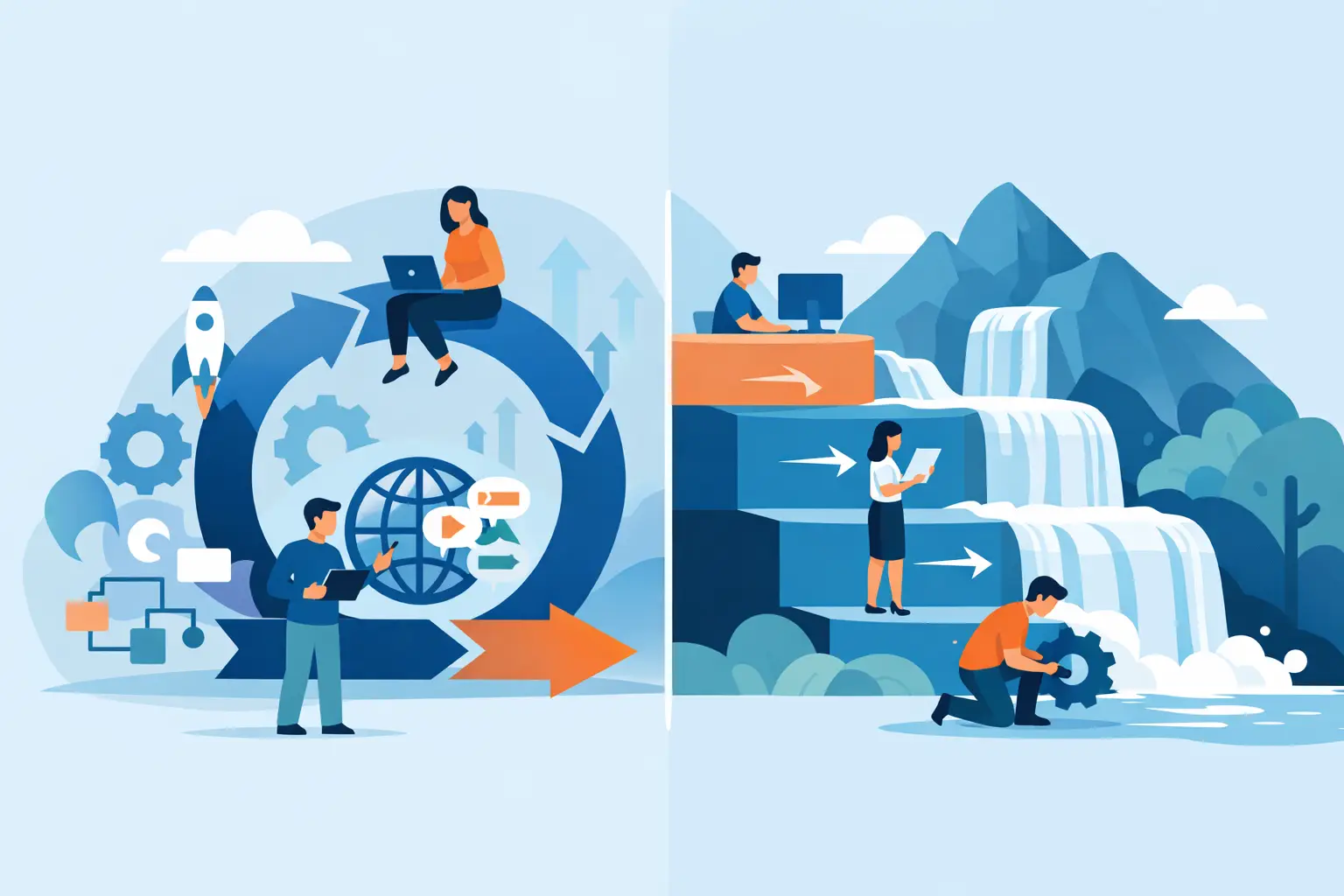
A release is ready for QA, strings changed three days ago, and the localization team is still waiting for the final resource files. That is usually the moment the real debate starts: continuous localization vs waterfall. For software teams shipping frequent updates, this is not a theoretical process discussion. It affects release timing, translation quality, build stability, and how much manual coordination your team absorbs every sprint.
Continuous localization vs waterfall: the core difference
Waterfall localization treats translation as a downstream phase. Development happens first, source content stabilizes, files are handed off, translation is completed, and localized assets return near the end of the cycle. This model assumes the product can pause long enough for language work to catch up.
Continuous localization works differently. New or changed strings are detected as development progresses, translation starts earlier, and validated outputs are generated repeatedly during the build cycle. Instead of waiting for a large handoff, the localization workflow moves in smaller increments alongside engineering.
That sounds like an easy choice, but the right model depends on release cadence, file complexity, governance requirements, and how mature your tooling is. A quarterly desktop release with strict content freeze points has different constraints than a SaaS platform deploying weekly.
Why waterfall still exists
Waterfall remains common because it is easy to understand and relatively easy to govern. Teams know when the handoff happens, who owns each phase, and when language vendors are expected to deliver. If product text changes infrequently and release dates are broad enough to absorb translation turnaround, waterfall can be perfectly serviceable.
It also fits environments where localization is centralized and highly controlled. Some enterprise teams prefer a hard source freeze, formal review cycles, and sign-off gates before any translated files are generated. In regulated settings, that predictability can matter more than raw speed.
There is another practical reason: legacy systems. Many organizations still manage resource extraction, packaging, and QA through scripts and manual processes built around milestone-based releases. Reworking that infrastructure for continuous execution requires time and internal buy-in.
Where waterfall starts to break down
The problem is not that waterfall is wrong. The problem is that it becomes expensive when the product changes often.
If strings are exported late, translators work under tighter deadlines. If developers keep modifying UI text after handoff, you either absorb rework or ship with outdated translations. If localization QA happens close to release, defects are discovered when engineering time is already constrained.
This delay compounds across channels. A desktop application, web portal, mobile app, help content, and release notes may all depend on different file formats and different owners. In a waterfall process, every dependency tends to converge at the end, which is exactly when teams have the least flexibility.
The result is familiar: missed language parity, manual file merges, repeated terminology fixes, and localized builds that arrive too late for proper testing.
How continuous localization changes the workflow
Continuous localization shifts localization from a release event to an operating process. Source files are scanned regularly, changed strings are identified automatically, translation assets are updated incrementally, and generated outputs are fed back into the build or delivery pipeline.
For engineering teams, this matters because the workflow becomes measurable and automatable. You can detect untranslated strings earlier, validate placeholders before release, catch formatting errors during build execution, and keep translation memory current while features are still moving.
For localization managers, the gain is not just speed. It is better control over change. Smaller batches are easier to review, easier to route, and less likely to hide terminology drift or UI truncation issues. Translators also benefit from fresher context because they are not working weeks after the original feature work was completed.
Continuous localization vs waterfall in real software teams
The clearest advantage of continuous localization is cycle-time reduction. If your product releases weekly or even monthly, waiting until the end of development to start translation creates avoidable latency. Continuous workflows let language work progress while code is still being integrated.
Quality often improves as well, but only if the workflow is implemented correctly. Early translation alone does not guarantee better results. Teams need validation rules for variables, tags, and syntax. They need translation memory and terminology management so repeated strings stay consistent. They also need visual or structural context for UI and document formats that cannot be translated safely as plain text.
This is where many teams underestimate the technical side. Continuous localization is not just "send strings faster." It requires stable extraction logic, file-format awareness, automated QA, and deployment-ready output generation. Without that foundation, you can end up accelerating errors instead of preventing them.
The trade-offs between the two models
Waterfall gives you batching efficiency. Vendors can process large volumes at once, review cycles are centralized, and project accounting is straightforward. If your content is mostly static and your teams prefer scheduled handoffs, that simplicity has value.
Continuous localization gives you responsiveness. String changes can move through translation without waiting for a full release milestone, and localized builds can stay closer to source parity. That is especially useful for agile product teams, CI/CD environments, and applications with ongoing UI refinement.
But continuous models also introduce operational demands. Teams need ownership for connectors, scanners, build jobs, and validation policies. They need to decide what happens when source text changes after translation starts. They need branch and version strategies so translators are not working on stale or conflicting content.
In other words, the trade-off is not simple speed versus slowness. It is structured batching versus ongoing orchestration.
When waterfall is still the better choice
Waterfall can still be the right answer when releases are infrequent, source content is tightly controlled, and localization volume arrives in large, predictable batches. It also fits teams that rely on extensive linguistic review before publishing and cannot justify pipeline automation for a low release frequency.
It is often reasonable for document-heavy projects with formal publication cycles, especially when content must be finalized before translation begins. The same applies to products with limited language scope and little UI volatility.
If your process works, your defect rate is low, and your release schedule has enough buffer, there may be no immediate reason to replace waterfall completely.
When continuous localization is the better fit
If your developers ship continuously, your localization workflow should not depend on a freeze that rarely holds. Continuous localization is usually the better fit for SaaS products, mobile apps, content-rich platforms, and enterprise software with parallel feature streams.
It is also a strong choice when your product spans many formats. Resource files, structured documents, databases, and web assets all benefit from a unified workflow that can scan, translate, validate, and generate outputs without forcing teams into separate tools. In practice, this is where a platform such as Soluling becomes useful because the value is not just automation. The value is handling complex formats, quality checks, translation memory, terminology, and build-server execution in one controlled environment.
That last point matters for security-conscious organizations. Some teams want continuous localization but do not want to expose source code or repositories to external services. Local scanning and build-time processing solve a real operational problem, not just a compliance checkbox.
A practical way to choose
Start with release cadence. If your product changes weekly, waterfall will eventually become a bottleneck unless localization scope is tiny. Next, look at file complexity. The more formats you support, the more expensive manual handoffs become. Then evaluate governance requirements. If every string requires formal review, continuous localization may still work, but the approval flow needs to be designed upfront.
You should also examine where your current defects originate. If issues come from late discovery of missing strings, broken placeholders, or outdated translated resources, a continuous model can address those directly. If most problems come from unstable source text and weak content ownership, changing the localization model alone will not fix them.
For many teams, the best path is hybrid. Stable documentation or regulated content can remain in waterfall, while product UI and fast-moving digital assets shift to continuous localization. That approach reduces risk while still removing the biggest release bottlenecks.
The useful question is not which model sounds more modern. It is which one matches the way your product is actually built. If localization is part of shipping software, it should run with the same discipline as the rest of your delivery pipeline.