Localization Platform vs Translation Management
August 9, 2026
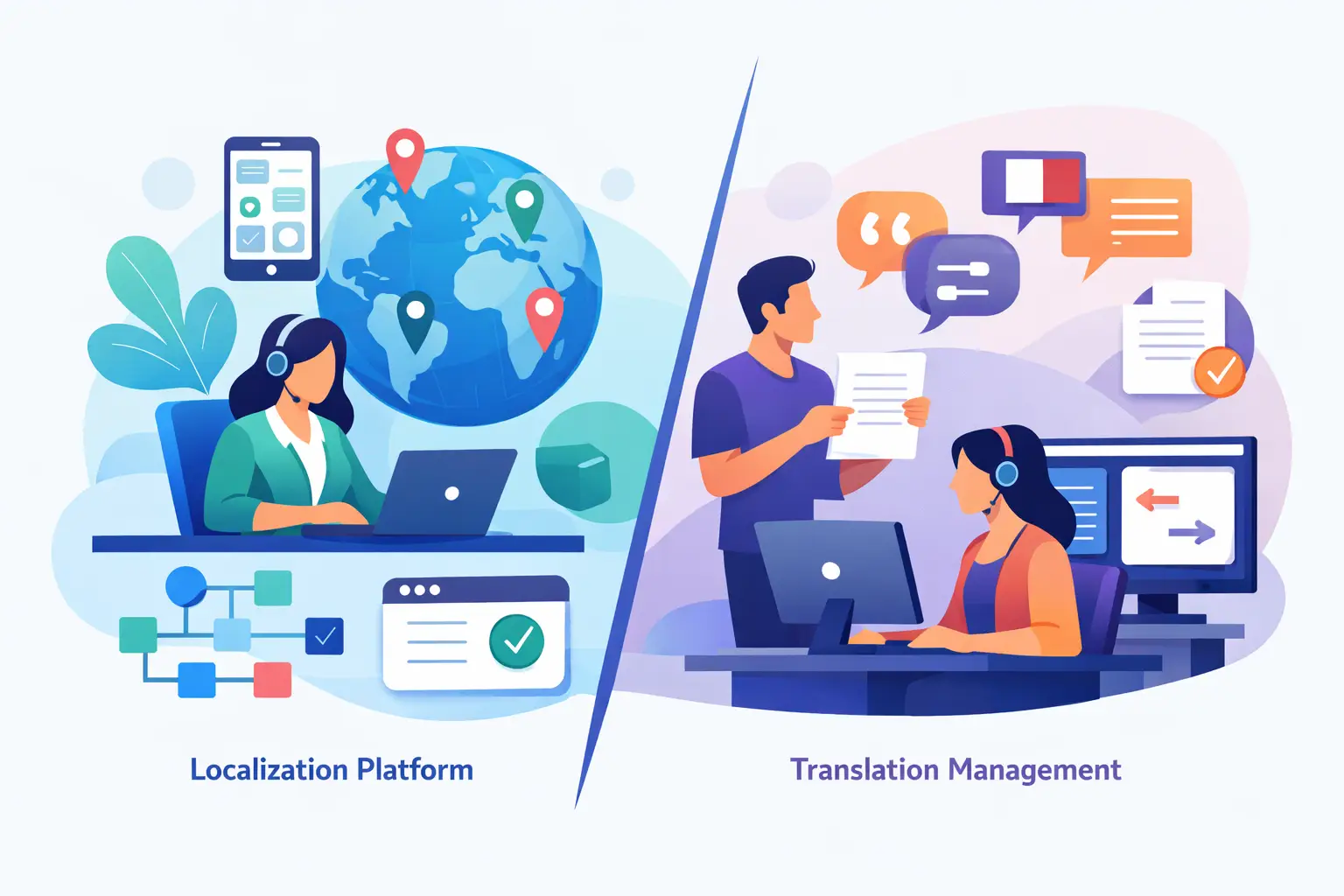
A release branch is not a translation project in the abstract. It contains resource files, UI constraints, placeholders, markup, build rules, screenshots, terminology, and deadlines. That is why the distinction between a localization platform vs translation management matters to software teams: one approach coordinates translation work, while the other must also produce technically valid, deployable multilingual software.
The terms are often used interchangeably, and many products overlap. But the operational difference becomes clear when a team needs to scan source files, protect code, validate translated resources, generate target files, and ship them through the same pipeline as the product itself.
What translation management is designed to do
Translation management usually refers to the processes and systems used to organize multilingual content. A translation management system, or TMS, commonly centralizes projects, assignments, due dates, linguistic assets, vendor communication, review stages, and translation status.
For localization managers handling websites, support content, marketing materials, or documentation, these capabilities are valuable. A TMS can route strings to translators, apply translation memory matches, enforce terminology, collect reviewer feedback, and provide cost or throughput reporting. It replaces email attachments and spreadsheet-based handoffs with a controlled workflow.
That workflow focus is its main strength. If source content is relatively simple and the primary challenge is coordinating people across languages, translation management may be enough. A content team publishing a set of static documents, for example, may need strong assignment rules and approval visibility more than build integration.
The limitation appears when a translated file is not automatically ready for production. Software resources contain more than text. They may include identifiers, placeholders, plural forms, escape sequences, inline tags, character limits, access keys, layout constraints, and framework-specific syntax. Managing the translation does not necessarily validate or build the localized artifact.
What a localization platform adds
A localization platform treats translation management as one component of a larger technical workflow. It is built to process source formats, extract localizable content, preserve nontranslatable structure, provide context to translators, validate results, and generate output files that can move into a build or deployment process.
For software teams, that distinction affects every release. A platform should understand the formats used by the product rather than reducing every file to generic text. This can include .NET RESX resources, JSON, XML, YAML, XLIFF, Java properties, Android XML, iOS strings, Qt files, databases, HTML, Markdown, Microsoft Office documents, and other structured formats.
Format intelligence reduces failure modes that are expensive to find late. A missing placeholder can crash formatting code. An altered tag can break rendering. A duplicate key can overwrite a string. Text that technically fits in a resource file may still overflow a dialog, button, menu, or mobile screen. Localization platforms can detect many of these issues before a localized build reaches QA.
Visual editing is another practical difference. Translators and reviewers need more than a source string such as “Open.” They need to know whether it is a command, a status label, a file action, or a navigation control. Visual context, screen previews, and live validation help teams make the correct linguistic and UI decision earlier.
Soluling is an example of this platform-oriented model: it combines translation memory, terminology, machine translation, visual localization, validation, and output generation while working across more than 100 file formats. The objective is not merely to track a translation job. It is to create deployable localized assets.
Localization platform vs translation management for developers
The most useful comparison is not feature count. It is where the system sits in the delivery chain.
A translation management workflow often begins after someone exports content and ends when approved translations are returned. A localization platform can begin at source scanning and continue through target-file generation, automated validation, and build-server execution. The latter model is better aligned with continuous localization, where product changes arrive frequently and manual export-import cycles create release risk.
Consider a team shipping a desktop application in 12 languages. Engineers update strings in RESX files, product writers update embedded help content, and localization managers need to reuse approved translations. With a translation-only workflow, someone may export changed content, prepare packages, distribute them, reconcile the returned translations, and check whether the resulting files compile.
With a developer-focused localization platform, the workflow can be automated. The platform scans changed files, decouples translatable strings, applies translation memory and approved terminology, sends only new or changed content for translation, validates placeholders and file structure, then generates localized output resources. A build server can run the same steps as part of a controlled release process.
This does not eliminate human review. It removes repetitive technical handling so translators can focus on language and reviewers can focus on product fit.
Source-code control and security
Architecture matters as much as workflow. Many teams cannot upload proprietary source repositories, unreleased UI strings, database exports, or regulated content to a third-party service. Others need localization to work in isolated networks or under strict access controls.
A platform that supports local file scanning and build-server execution gives the organization more control over where source content is processed. Translation packages can be prepared without granting broad repository access to outside users. This approach is especially relevant for enterprise software, financial systems, healthcare products, and products still under embargo.
Cloud-based translation management can still be appropriate when centralized collaboration outweighs those constraints. The decision depends on content sensitivity, compliance requirements, existing DevOps practices, and whether the organization needs local execution as a hard requirement rather than a preference.
Quality control beyond linguistic review
Translation quality starts with terminology, context, and qualified translators, but software localization also requires technical quality assurance. A reviewer can approve a natural German translation that still exceeds a fixed UI field. A machine translation engine can return fluent text while changing a variable token or dropping markup.
A localization platform should support checks for missing or inconsistent translations, placeholder mismatches, invalid markup, duplicated values, length limits, accelerators, and other format-specific conditions. These checks are most useful when they run repeatedly, not only during a final manual QA pass.
Translation management tools may offer some QA rules, particularly for XLIFF-style workflows. The question is whether those rules understand the actual source formats and can verify the output that the product build consumes. For complex applications, that gap is often the deciding factor.
When translation management is sufficient
Translation management is often a sensible choice when content is primarily editorial, source formats are standardized and simple, releases are infrequent, and a separate technical team owns integration. It can also fit organizations that need extensive supplier portals, procurement controls, and centralized linguistic workflow across a large network of language service providers.
Even then, ask how translations return to the product. If the answer involves manual copying, custom scripts, or a final round of file repair by developers, the organization has a localization engineering problem that project management alone does not solve.
When a localization platform is the better fit
A localization platform is usually the stronger fit when multilingual delivery is tied directly to software releases. That includes products with multiple frameworks, structured or proprietary file formats, frequent releases, strict source-code controls, or a need for automated validation and target generation.
It is also useful for teams that manage both software and adjacent content. A single environment can maintain translation memory and terminology across applications, documentation, database content, and structured data while applying the validation appropriate to each format. This avoids fragmenting linguistic assets across one tool for UI strings, another for documents, and scripts for everything else.
The trade-off is that platform adoption requires technical setup. Teams must define project structure, language rules, validation policies, source locations, and build integration. That work is worthwhile when localization is recurring production infrastructure. It may be unnecessary for a one-time document translation project.
Before selecting a system, trace one real change from a developer commit to a localized release. Identify every export, handoff, transformation, validation step, and manual correction. The right choice is the one that makes those steps repeatable without separating translation quality from the software that customers actually install.