
|
Markdown Localization and Internationalization |
Markdown (Wikipedia) is a lightweight markup language. It is used to write readme files, documentation, documentation sites, blogs, and wikis. Soluling Desktop and Soluling Cloud support Markdown files (.md, .markdown).
The end of the document contains links to get the full source code of the samples. After reading this document, we recommend reading a tutorial about how to use Soluling.
Soluling reads the original Markdown file and extracts the text elements, such as headings, paragraphs, list items, and table cells. Inline formatting, such as bold, italic, code spans, and links, stays inside the strings so that the translator can translate whole sentences. When building, Soluling creates one localized Markdown file for each language. Take a look at the following simple Markdown file.
Sample
====

This is a sample.

Line one.
Line two.

This is **bold**, *italic*, ***both*** and `code`.

## List

- One
- Two
- Three
You can find the file in <data-dir>\Samples\Markdown\Simple\Simple.md. The file has several text parts that need to be translated. If we translate the above file into Finnish, we get:
Esimerkki
====

Tämä on esimerkki.

Rivi yksi.
Rivi kaksi.

Tämä on **lihavoitu**, *kursivoitu*, ***sekä*** että `koodi`.

## Lista

- Yksi
- Kaksi
- Kolme
The structure of the Finnish Markdown file is identical to the structure of the original English Markdown file; only the text in each element has been translated into Finnish. If you change the original Markdown file, use Soluling to rescan the file. Soluling aligns the elements again to keep the unchanged elements, adds the new elements, and marks the modified elements. You only need to translate the new elements and check the modified elements.
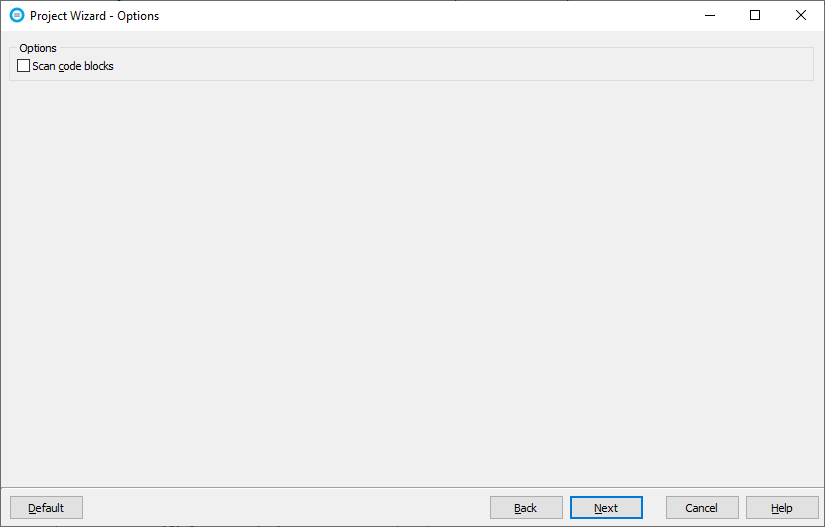
By default, Soluling does not translate code blocks, because they usually contain source code. If your code blocks contain text that should be translated, check Scan code blocks on the Options sheet.
Note! Write the localized files in UTF-8, the encoding that most Markdown tools, such as GitHub, expect. If your original file contains only ASCII characters, check the encoding on the Output sheet so that characters such as Finnish ä or Japanese characters are written correctly.
You can localize a Markdown file either in Soluling Desktop or in Soluling Cloud.
 Desktop process
Start by creating a new project for your Markdown file, for example, Simple.md. The Project Wizard first shows the Options sheet where you can configure what elements are localized.
Click Next to get to the Languages sheet where you can select the original language and add the target languages. You can later add any number of languages to the project.
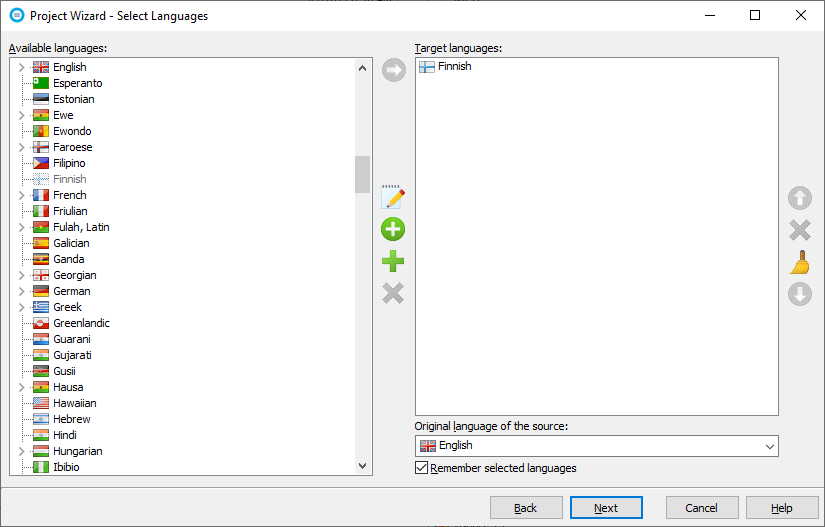
Select English as the original language and add one or more target languages. In our sample, we chose Finnish. Click Finish to complete the wizard. Soluling creates a project for the Markdown file, scans the file, and shows the elements in the editor.
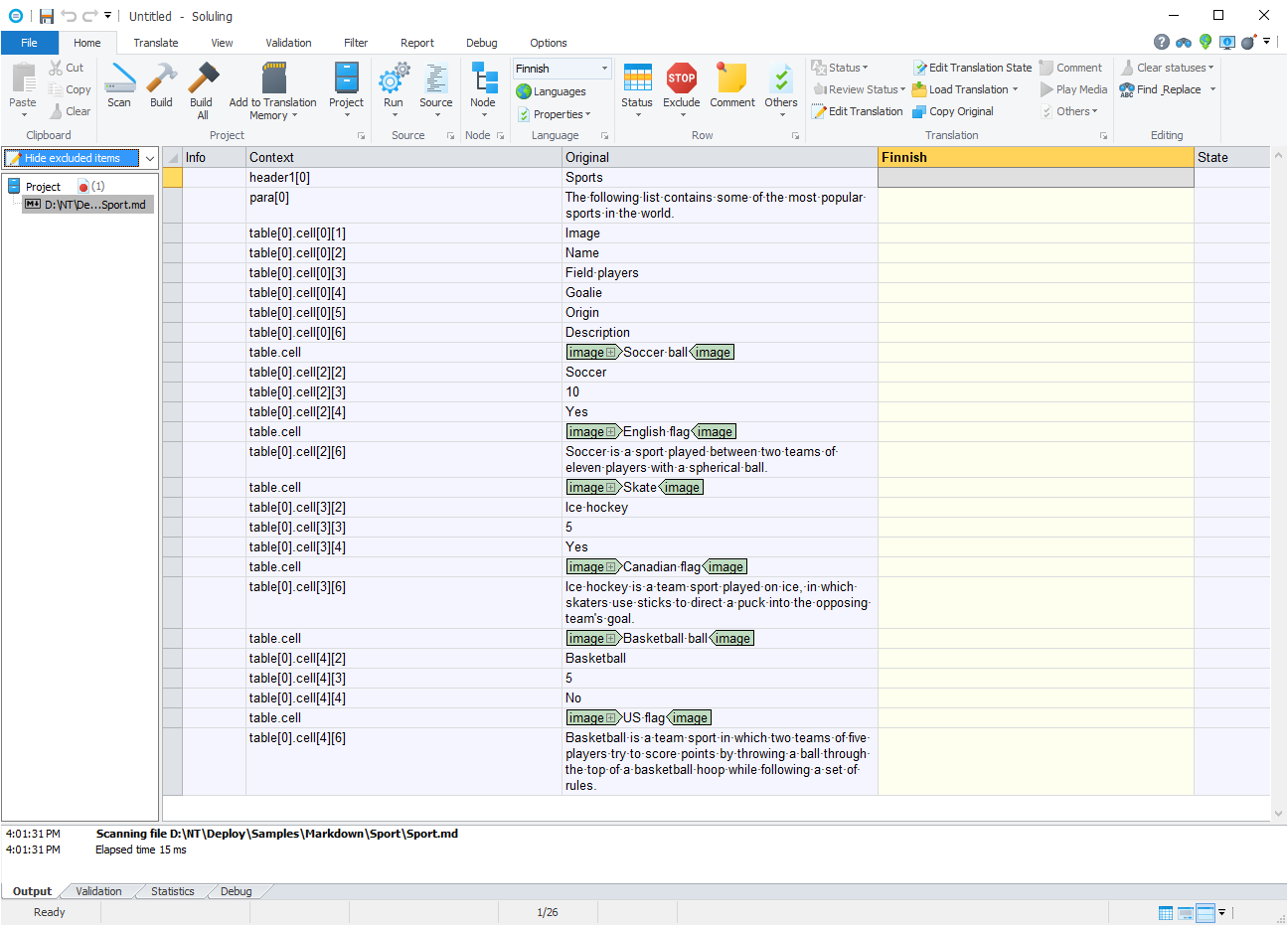
Follow the general translation instructions to translate your project.
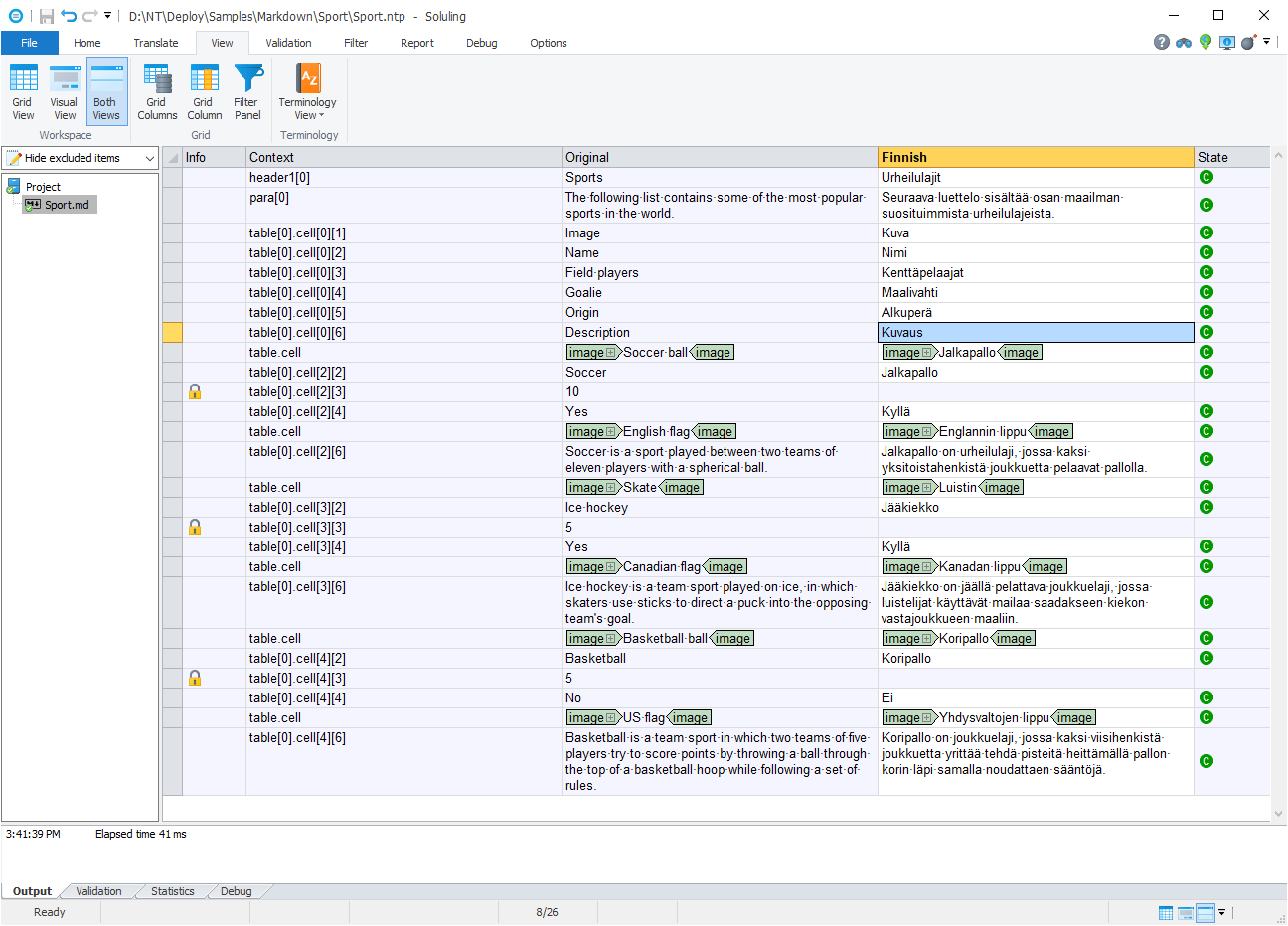
When you have translated the project, choose Home | Build All to build the localized files. The Finnish Markdown file is created into the fi subdirectory with the same name as the original file (e.g., fi\Simple.md).
 Cloud process
With Soluling Cloud, you translate the Markdown file in your browser: upload the file, translate it in Translate, and download the localized files. You need a Soluling account. See the available Cloud plans.
Simple.md), or drag and drop the file onto the page. Click Create.Click the project's green Translate button on the dashboard. Translate opens the project, and you can type the translations into the grid. Machine translation suggestions, translation memory, and spell checking are available there. You do not have to finish every language before moving on to the next step.
Inline formatting, such as bold text, code spans, and links, is shown as protected tags.
When you change the original Markdown file, upload it again, translate what is new or changed, and download the localized files again. On the dashboard, click the project's Update file button (the upload arrow), select the new file or drop it onto the page, and click Update. Existing translations are kept, so you only translate the text that was added or changed.
If you want to translate code blocks, create the project in Soluling Desktop, where you can set the option, and upload it to Soluling Cloud. See the Cloud tutorial.
GitHub and <data-dir>\Samples\Markdown contain the following Markdown sample directories:
| Directory | Description |
|---|---|
| Simple | A simple Markdown file (Simple.md) that contains headings, paragraphs, formatted text, and a list. Study this first. The directory also contains Utf8.md and Utf8Bom.md that show how Soluling handles UTF-8 files with and without a byte order mark. The localized files are in the fi and ja subdirectories. |
| Sport | A Markdown file that contains a table with text, numbers, and images. The localized file is in the fi subdirectory. |
You can configure how to localize your Markdown file by selecting the item in the project tree, right-clicking, and choosing the Options menu. A source dialog appears that lets you edit the options. This source uses the following option sheets.
Read more about other document files such as DITA, Help+Manual, HTML, HTML Help, LaTeX, Word, PowerPoint, Markdown, RTF, and PDF files.
 Copyright © 2016-2026 Soluling Oy