Migrate from Sisulizer, Multilizer, and More
Soluling makes it easy to migrate from other localization tools.
 Sisulizer
For years Sisulizer was the number one tool to localize your Delphi, C++ and .NET applications. The company has ceased operations.
The good news is that Soluling has all the excellent features of Sisulizer, plus those that Sisulizer lacked, such as:
- Interactive and fuzzy enabled translation memory.
- Interactive terminology support.
- 64-bit application. Soluling comes with both 32-bit and 64-bit versions.
- Support for all .NET Framework, .NET Core, and .NET 5 and later.
- Support for all VCL and FireMonkey applications.
- Support for modern web application.
- Native visual editors that give you 100% WYSIWYG. Sisulizer used emulated controls.
- Build automation that also works on the cloud based CI/CD pipeline.
- Excellent support.
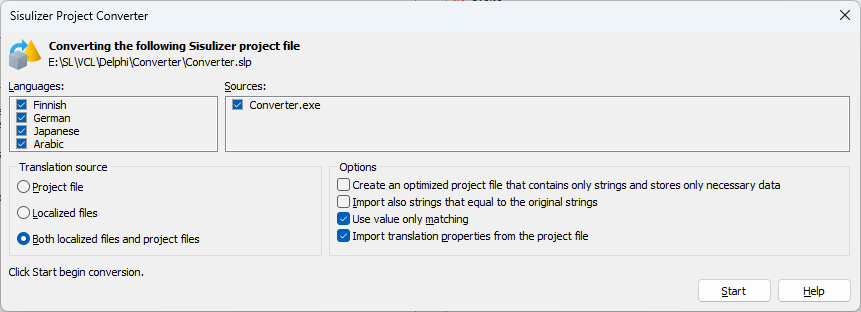
Soluling can convert your existing Sisulizer project files (.slp) into Soluling project files (.ntp). Follow these instructions.
 Multilizer
 was a popular localization tool for Delphi, Java, and Visual C++ applications in the early 2000s. The company has ceased operations.
Soluling can convert your existing Multilizer project files (.mpr, .m7p) into Soluling project files (.ntp). Follow these instructions.
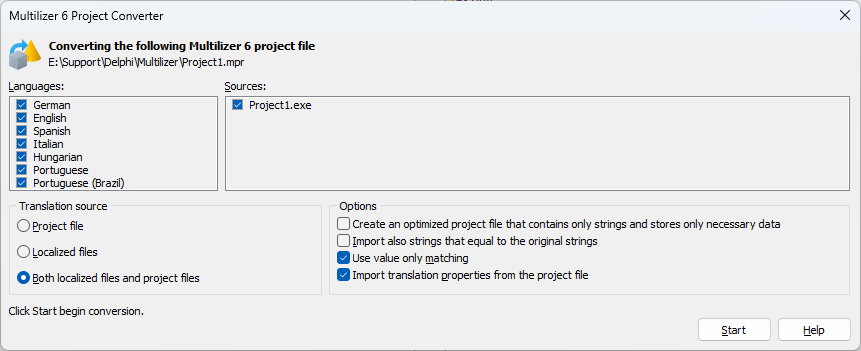
Note! Soluling can convert Multilizer 6 or later project files. Soluling can also convert some Delphi projects from Multilizer 5.
Applications using Multilizer components
You have two options to migrate your application that uses Multilizer components. The first option is to refactor your code to use the standard Delphi internationalization. The second option is to keep your existing Translate functions and start using the Project localization.
Option A: Refactor your code to use the standard Delphi internationalization
The recommended action is to refactor your application to use the standard Delphi internationalization. This means using resourcestring to store your source code strings outside the form files. Once you have refactored your code, follow the standard instructions to use binary localization with a VCL application..
Option B: Keep Translate functions
Another option is to keep your existing Translate functions and start using the Project localization.
This means that you add .dproj file into your Soluling project instead of .exe.
Soluling's project localization library uses _T function instead of Translate. If you don't want to change that, create a simple wrapper such as
function Translate(const value: String): String;
begin
  Result := _T(value);
end;
Reuse existing translations
The easiest way to reuse your existing translations is to import them from your .mld file.
- First download MldToTmx.exe (MLD to TMX utility application).
-
Use the utility to convert your
.mldfile to a.tmxfile.MldToTmx.exe your_file.mld
- Finally import the
.tmxfile into your Soluling project.
Other desktop localization tools
For other desktop localization tools, but Sisulizer and Multilizer, there is no automatic conversion. However, if you have the existing localized files in standard locations, then Soluling will find them and automatically import the translations after you have added the original file into your Soluling project.
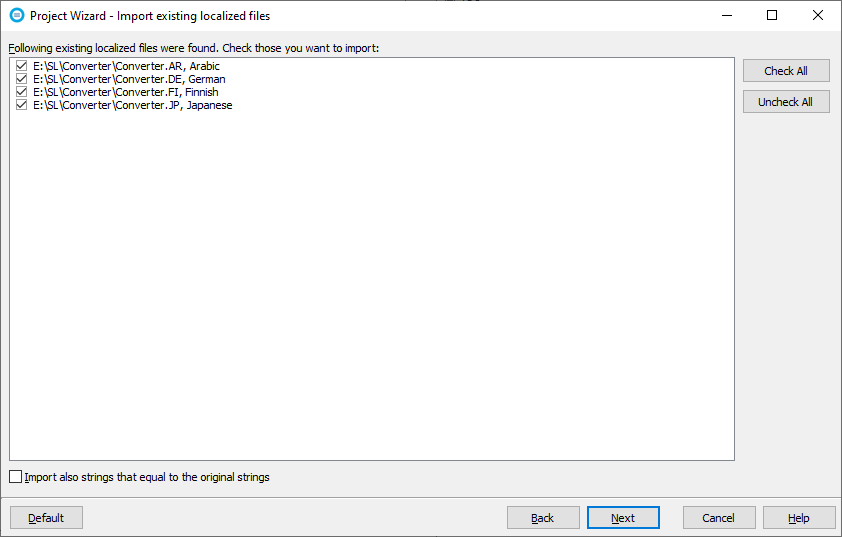
If your localized files are in a location that Soluling does not find, then you can manually select the files and import them one by one.
If the above does not work, then use your previous localization tool to export translations into XLIFF, TMX or Excel. Then create a Soluling project and import the translations.
Other cloud based localization tools
For other cloud based localization tools there is no automatic conversion. However, if you have the existing localized files in standard locations, then you can upload the localized files with the original files to the cloud and Soluling will automatically import the translations after you have added the original file into your Soluling cloud project.