AI Translation Governance Trends for Software
September 24, 2026
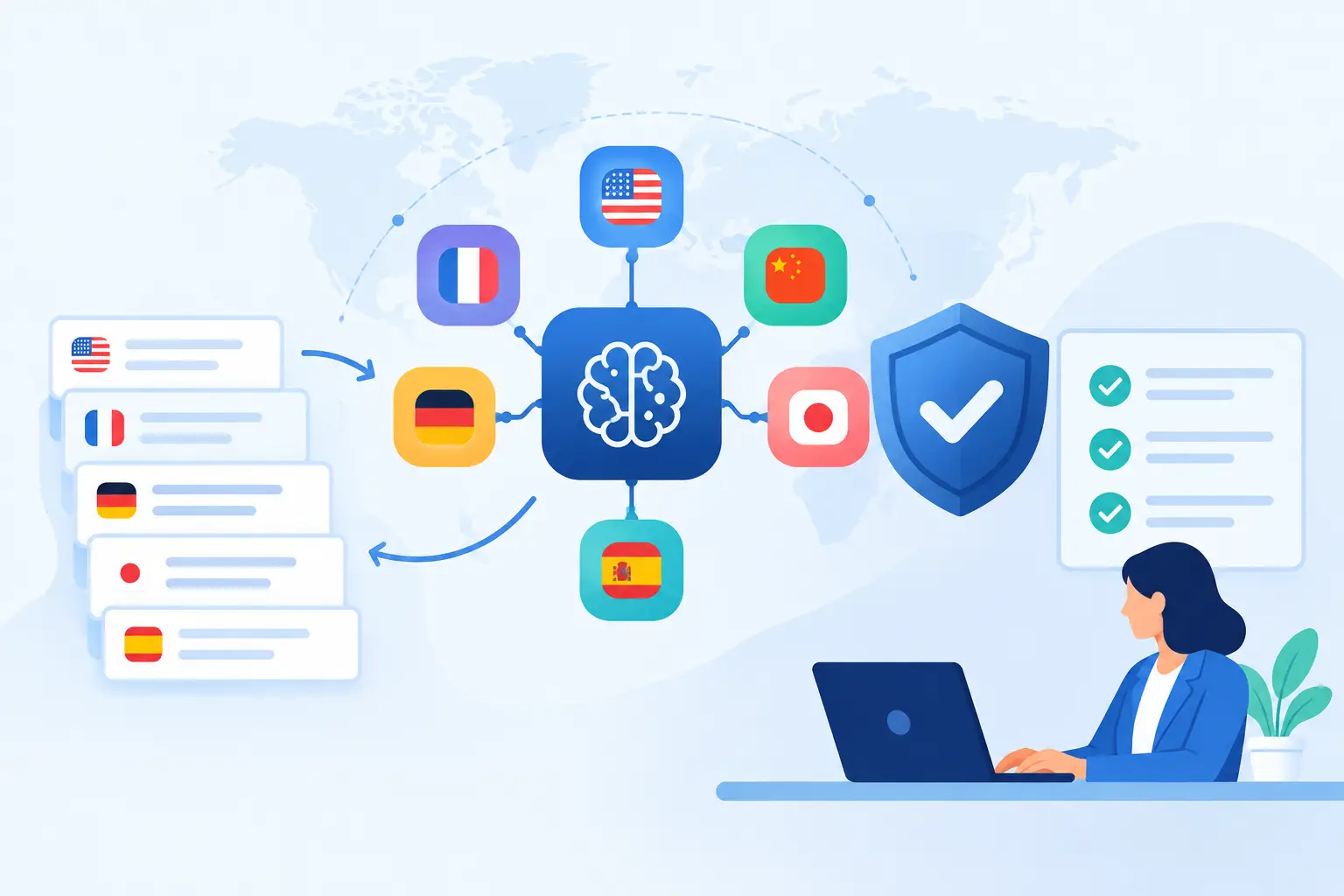
A product team can now translate a new feature into 20 languages in minutes. The harder question is whether those translations used approved terminology, stayed within data-handling rules, preserved placeholders, and can be traced to a specific model, prompt, and reviewer. That is why AI translation governance trends matter to software organizations: translation speed has outpaced the controls traditionally used to protect quality and release integrity.
For development teams, governance is not a policy document stored in a shared drive. It is the set of technical and operational controls that determines what content may be sent to an AI service, which engine handles it, how results are validated, who can approve exceptions, and what reaches production.
Why AI Translation Governance Trends Are Moving Upstream
Early machine translation governance often focused on procurement. Localization leaders reviewed a provider’s security terms, selected a translation engine, and gave translators guidance on when to use it. Generative AI changes the scope. Teams may now use AI for first-pass translation, terminology checks, transcreation suggestions, content classification, linguistic QA, and issue triage.
That wider use makes governance an engineering concern. A prompt can contain unreleased product details. A translation can alter a variable, markup tag, ICU message, access key, or character limit. A seemingly harmless UI string can have legal or safety implications when it appears in a healthcare, finance, or enterprise administration workflow.
The practical trend is to govern AI at the point of content movement. Instead of asking people to remember rules before uploading files, teams are building approved paths into their localization workflow. Source files are scanned locally, content is classified before processing, and only eligible segments are routed to an allowed AI provider or model.
This approach is particularly useful for repositories that contain a mix of public UI text and sensitive material. A release notes file may be appropriate for a managed translation engine, while an unreleased security configuration screen, customer-specific document, or database extract may require a private deployment, an approved internal model, or human translation only. The right rule depends on content sensitivity, contractual commitments, and the model’s data-retention terms.
Data Boundaries Become Model Routing Rules
The most visible governance trend is the replacement of a single approved-engine policy with model routing. Different content types have different risk and quality profiles, so a single AI endpoint is rarely the best answer.
A controlled routing policy typically evaluates the content’s classification, target locale, file type, required turnaround, and whether a translation memory match exists. Exact and high-quality fuzzy matches can be reused without invoking AI. Strings marked confidential can be excluded from external processing. Lower-risk, repetitive UI content can be routed to a machine translation engine with terminology enforcement. Marketing copy or regulated instructions may require a human review queue regardless of AI output quality.
Routing also needs to account for deployment location. Some organizations require regional processing, while others need assurance that source content is not retained for model training. These requirements should be represented as executable workflow settings, not interpreted manually on every project.
Keep the source code boundary intact
For software teams, the question is not only where translated text goes. It is also what must leave the build environment to obtain it. Cloud-only localization workflows can force repositories, resource files, or package artifacts through third-party systems even when only translatable strings are needed.
Local scanning and build-server execution reduce that exposure. The localization system can extract translatable content from supported resource formats while keeping source code and repositories under customer control. It can then generate deployment-ready localized files after translations pass validation. This creates a clearer audit boundary: the organization can identify the exact content sent for translation and the artifacts produced from it.
Terminology Is Becoming a Hard Control
AI models are good at producing fluent language. Fluency alone does not make a translation suitable for a software product. Product names, feature labels, legal terms, commands, and technical concepts must remain consistent across UI strings, documentation, help content, and support materials.
As a result, terminology management is shifting from reference material to an enforceable control. An approved termbase should guide AI translation before output is created, then be checked again during QA. The workflow needs locale-specific rules for prohibited terms, untranslated tokens, capitalization, gender, and grammatical variants where applicable.
This is especially important when the same string appears in different technical formats. A button label may be stored in a .resx resource, a JSON bundle, an Android XML file, and a documentation source file. Governance should preserve a common translation memory and terminology layer across those formats while respecting their syntax and context.
Teams should also establish ownership. Product management may own feature naming, legal may approve regulated wording, and localization may maintain locale-specific equivalents. Without a defined owner and change process, AI will amplify terminology drift faster than humans can correct it.
Quality Governance Is Shifting From Sampling to Evidence
Traditional linguistic QA often relies on review samples near the end of a release. That remains useful, but AI-driven throughput makes sampling alone insufficient. A small percentage of errors across thousands of strings can still create a large production defect backlog.
The growing practice is to combine automated validation with risk-based human review. Automated checks should verify placeholders, variables, markup, line breaks, duplicate translations, length limits, encoding, and locale-specific file rules. Visual review should confirm that translations fit the interface, match screenshots or live context, and retain the intended meaning in menus, dialogs, tables, and error messages.
AI output should be measured using production-relevant signals rather than generic model claims. Useful metrics include terminology compliance, placeholder error rate, post-edit distance, rejection rate by content type, escaped-defect rate, and time from source-string change to approved target artifact. Segment-level quality scores can help prioritize review, but they should not silently approve high-risk content.
A governance program also needs a feedback loop. When reviewers correct a recurring issue, that correction should update translation memory, terminology, prompts, routing rules, or model selection. Otherwise, the team pays to fix the same defect in every release.
Auditability Must Cover the Entire Translation Decision
When a release manager asks why a particular German string changed, the answer cannot be simply that AI generated it. A usable audit trail connects the target string to its source version, translation memory match or model, prompt template, terminology version, validation results, reviewer decision, and the build that created the final file.
This level of traceability supports regulated environments, customer security reviews, and ordinary debugging. It also makes model changes manageable. If a provider updates a model or a team changes prompt instructions, teams can compare quality and cost against a known baseline rather than discovering variation after release.
Versioning matters here. Treat prompts, terminology, AI settings, QA rules, and routing policies as controlled configuration. They should be reviewed, tested, and promoted through environments much like application code. A policy that changes without a record is difficult to defend and almost impossible to improve systematically.
Governance Is Entering CI/CD Pipelines
The most durable AI translation governance trend is integration with the release pipeline. Localization can no longer be a disconnected handoff if software teams ship continuously.
In a controlled pipeline, a source change triggers resource scanning and extraction. Translation memory is applied first, eligible segments are sent through the configured AI workflow, and validations run before localized output is generated. Failed checks create actionable issues: a missing placeholder, an unapproved term, invalid XML, an untranslated string, or a text expansion that exceeds a defined UI limit.
Not every product needs fully automated publishing. A consumer app with frequent UI updates may accept automated delivery for low-risk locales and strings. An enterprise platform with contractual terminology and regulated workflows may require an approval gate before merge or release. The useful design is not maximum automation. It is automation with explicit decision points and reliable rollback options.
Platforms such as Soluling support this model by combining format-aware localization, translation memory, terminology, AI-assisted translation, validation, and build automation in a workflow that can execute under customer control. That consolidation reduces the number of disconnected systems that must each enforce the same policy.
Assign Accountability Before an Incident Forces It
AI governance fails when responsibility is vague. Engineering cannot independently decide legal language. Localization cannot approve a security exception. Procurement cannot validate a broken ICU message. Teams need defined owners for data policy, model approval, terminology, quality thresholds, and release exceptions.
The goal is not to create a committee for every string. It is to create a fast path for routine content and an escalation path for exceptions. A developer should know why a segment was blocked and how to resolve it. A localization manager should be able to change an approved term without asking an engineer to edit files. A release manager should have evidence that required checks passed.
The strongest programs make the governed path easier than the workaround. When approved AI translation is integrated with repositories, file formats, validation rules, and deployment outputs, teams can ship multilingual software quickly without turning every release into a data and quality gamble.