JSON Versus PO Translation: Which Fits Your Build?
October 4, 2026
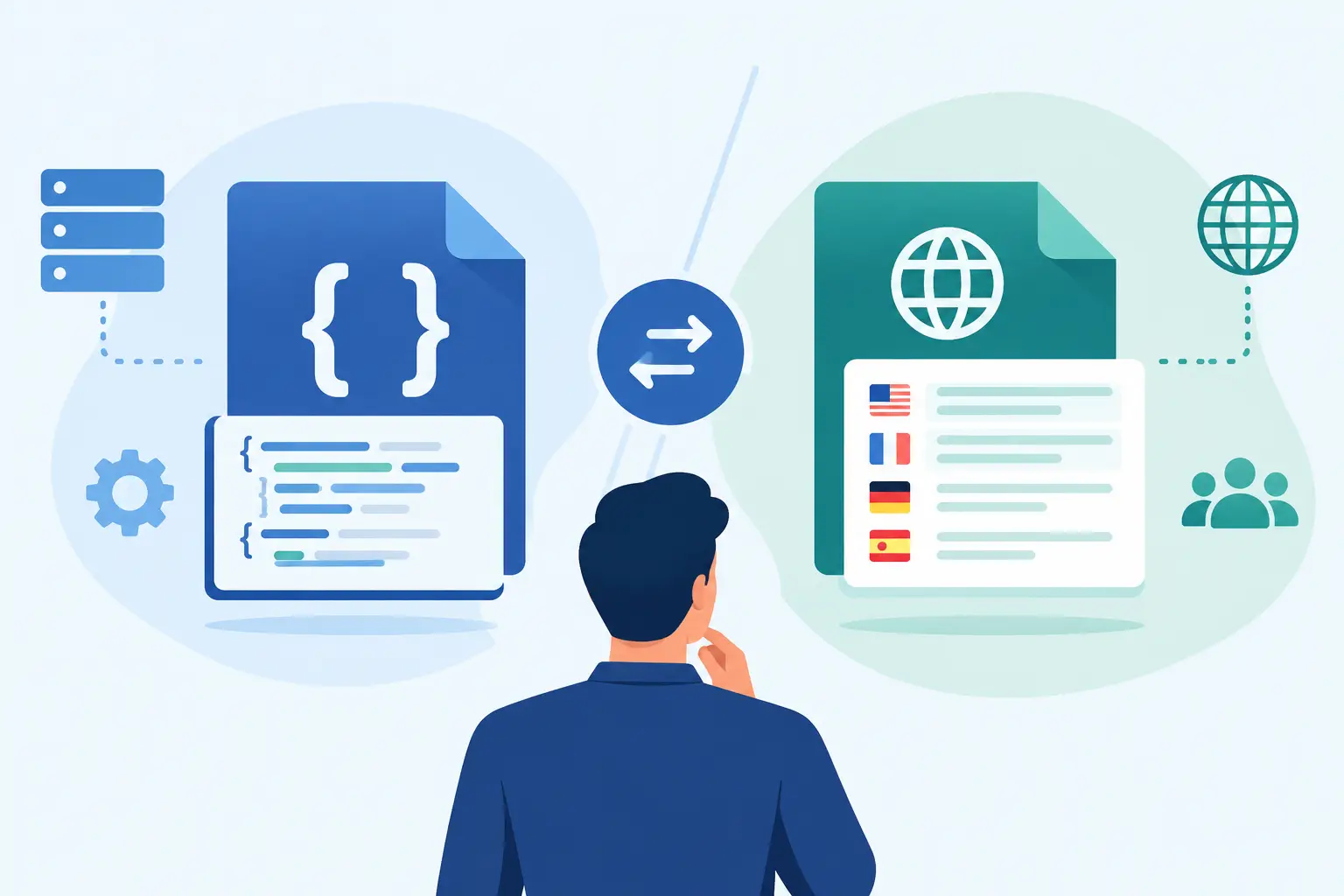
A localization format decision becomes expensive when it is treated as a storage preference. JSON files may fit naturally into a web application repository, while PO files provide translation-specific metadata that translators and localization tools can use immediately. The right choice in JSON versus PO translation depends on more than developer familiarity. It affects context, plural handling, validation, automation, and the quality of the files delivered to production.
JSON versus PO translation: the core difference
JSON is a general-purpose structured data format. In localization, it commonly stores a key and its translated value, often in nested objects that mirror an application's features or screens.
```json { "account": { "save": "Save changes", "cancel": "Cancel" } } ```
PO, short for Portable Object, is the established gettext translation format. It stores source text and translated text, but it also carries information designed specifically for localization workflows.
```po #: AccountSettings.tsx:42 msgctxt "account button" msgid "Save changes" msgstr "Save changes" ```
That distinction matters. JSON is concise and straightforward for an application runtime to load. PO is a translation interchange format with explicit support for source references, translator comments, contexts, review flags, and plural forms. Neither format is automatically better. The format must match the runtime, the localization process, and the degree of translation control the product requires.
When JSON is the practical choice
JSON is common in JavaScript, TypeScript, React, Angular, Vue, Node.js, and mobile or API-driven products. Developers already parse it, test it, diff it, and package it. A JSON resource file can also hold configuration-like localization data, such as localized labels, menus, and structured help content.
Its readability is a practical advantage. Engineers can usually add a key without learning a separate localization syntax, and nested keys can reflect application structure. For a small product with a limited number of languages, this can make localization feel close to normal feature development.
JSON is also flexible. Teams can choose identifier-based resources such as `settings.save`, English source text as keys, or a hybrid convention. They can model plural values as nested objects, arrays, or message strings. That flexibility is useful, but it creates a governance requirement: every locale must follow the same convention, and the application must interpret it consistently.
The weaknesses appear as the project grows. Standard JSON has no built-in translator comments, source references, review state, fuzzy-match status, or universal plural convention. A key such as `button.save` provides limited context to a translator. If the same English word appears as a verb, noun, toolbar command, and dialog title, the key naming strategy must provide the distinction that PO stores directly as context.
JSON also accepts any valid string value. That means a syntactically valid file can still contain an untranslated source value, a missing nested key, an invalid ICU message, or a broken placeholder. These issues require format-aware validation rather than simple JSON parsing.
Where PO files have an advantage
PO was built for translated software resources. A PO entry can preserve the original text, the translated text, the file and line where the string was extracted, notes for translators, and workflow metadata. This gives localization managers and linguists substantially more information without asking developers to encode it into key names.
Plural support is a particularly important advantage. Languages do not all use English singular and plural rules. PO headers declare the language-specific plural formula, and each plural entry contains the required translated forms. A localization tool can verify whether those forms are complete before generating runtime resources.
PO also supports message context through `msgctxt`. Consider the word "Open." It can be an adjective, a command, or a status. Separate contexts let translators produce distinct translations while preserving the same source string. Comments and source references then explain where each string appears.
These features make PO well suited to products with many translators, frequent releases, or a need for formal translation review. Translation memory systems also work effectively with PO because the source language, context, and prior translations are visible in the file structure.
The trade-off is that most applications do not consume PO files directly. A build step usually compiles PO into the format required by the framework or runtime, such as JSON, JavaScript modules, binary catalogs, or platform-specific resource files. Teams must maintain that generation step and ensure generated files remain synchronized with the source catalogs.
Context is the decision most teams underestimate
A resource format should preserve enough context for a translator to make the correct decision without inspecting source code. JSON can do this, but it depends on deliberate design. Keys such as `dialog.deleteProject.confirmation` are much more useful than `delete_1`. Developer comments may help as well, provided the extraction and translation process keeps them available.
PO provides a clearer path because comments, references, and contexts are part of the format. It is especially valuable when strings are short, reused, or ambiguous. The fewer words a string contains, the more likely it needs context.
Visual context remains valuable in either format. Screenshots, visual editors, and runtime previews reveal truncated buttons, incorrect gender agreements, duplicated punctuation, and labels that become confusing when translated. File metadata supports quality, but it does not replace seeing the user interface.
Plurals, placeholders, and rich messages need validation
The most serious localization defects are often valid files that fail at runtime. A translated string may omit `{count}`, alter `%s`, corrupt an HTML tag, or use a plural form the application cannot resolve. These are build-quality failures, not editorial preferences.
With JSON, teams should define one message convention and validate it consistently. For example, if the product uses ICU MessageFormat, every locale should preserve the required arguments and use syntactically correct ICU patterns. If plural entries are objects with `one` and `other` keys, validators should check that every target language has the categories the runtime expects.
With PO, plural definitions and placeholder validation can be checked against the source entries during catalog processing. PO does not eliminate errors, but its localization-specific structure gives tooling a stronger basis for detecting incomplete or inconsistent translations.
In both cases, validation should run before release artifacts are generated. Check for missing translations, duplicate keys, changed placeholders, malformed markup, invalid escape sequences, and resource encoding issues. Where possible, make these checks part of continuous integration rather than a manual pre-release task.
Choose based on the runtime, then design the workflow
If a framework expects JSON and the product has a small, engineering-led localization process, JSON may be the cleanest source format. It keeps the repository familiar and avoids a conversion layer. The team should still adopt stable keys, meaningful hierarchy, a documented plural strategy, and automated validation.
If the product needs detailed translator guidance, formal review states, standard gettext tooling, or language-aware plural handling, PO is usually the better working format. The build can convert catalogs into JSON or another runtime resource as a controlled artifact. This separates translator-friendly source catalogs from application-friendly delivery files.
A hybrid workflow is also common. Developers maintain application strings in JSON or code-level message definitions, extract them into PO for translation, and generate localized JSON during the build. This approach works well when engineering needs native framework integration while localization teams need context, translation memory, and quality controls.
The risk in a hybrid model is drift. If extraction, translation, and generation are not automated, a new source string can miss the catalog, a translated catalog can fail to compile, or an outdated generated file can ship. Treat the conversion as a reproducible build operation, not as a file handoff.
Build automation and source-code control
Localization resources deserve the same discipline as other release inputs. Store authoritative files in source control, scan them locally or on a controlled build server, and generate deployment-ready outputs from a repeatable process. This preserves source-code control while allowing translators to work in tools suited to their role.
A format-aware localization platform can scan JSON and PO resources, maintain translation memory and terminology, validate placeholders and structure, and generate target files as part of the build. Soluling supports this type of workflow across structured data and software resource formats, allowing teams to keep source files and repositories under their own control.
Do not commit generated output blindly without a clear policy. Some teams version generated locale files because the application consumes them directly. Others generate them in the release pipeline. Either model can work, provided ownership, build inputs, and validation results are explicit.
Make the format serve the translation process
The best choice is rarely a philosophical preference for JSON or gettext. Choose JSON when runtime alignment and simple resource management outweigh the need for embedded translation metadata. Choose PO when the localization process needs strong context, plurals, review support, and compatibility with established translation tooling. Use a generated workflow when the application and the translation team need different representations.
Whatever format you select, make context, placeholder checks, plural behavior, and build-time validation non-negotiable. A translation file is not finished when it parses. It is finished when it is correct for the language, valid for the runtime, and ready to ship with the same confidence as the code around it.