Database Localization Tools for Reliable Releases
October 26, 2026
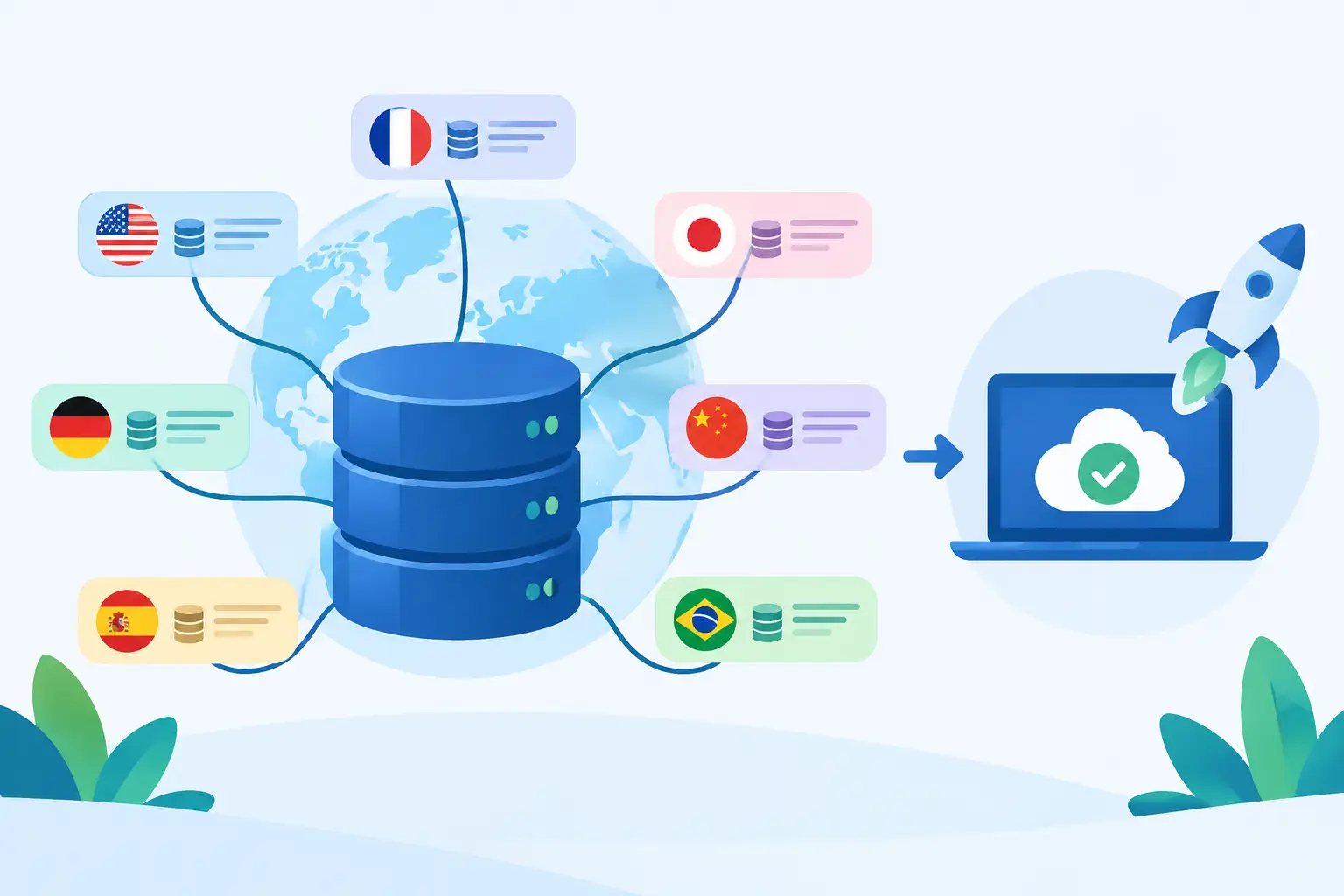
A product can have fully translated user interfaces and still fail internationally because the data behind those interfaces remains English-only, incomplete, or structurally inconsistent. Database localization tools address this gap by treating translatable database content as a controlled software asset rather than a spreadsheet export that is manually edited and re-imported.
For development teams, the central question is not simply how to translate database rows. It is how to identify the right fields, preserve keys and relationships, give translators enough context, validate the resulting data, and deploy it without breaking a release. The answer depends on the database model, the volume of content, and whether localization is a one-time project or part of every build.
What database localization tools need to handle
Database localization can mean several different things. In the most common case, a database stores product descriptions, help text, configuration labels, catalogs, templates, workflow messages, or other user-visible content. That content must be extracted, translated, and returned in a form the application can consume.
The database schema itself may also require localization-aware design. A single table with one text column works for one language, but it does not scale cleanly to many locales. Teams commonly use separate translation tables, locale-specific columns, JSON-based language values, or a content service that stores language variants outside the operational database. Each approach changes what a localization tool must scan, export, validate, and generate.
A capable tool should distinguish translatable values from identifiers, numeric fields, system metadata, HTML markup, placeholders, and protected tokens. It should also retain the information translators need to make correct decisions: table name, column name, record key, source language, target locale, and surrounding context. A value such as “Open” means something different in a support-ticket status field than it does in a button label.
Why direct database translation creates release risk
Editing production data directly is fast only until a change causes an incident. A mistranslated enum value can break an integration. A removed placeholder can cause a runtime exception. An unexpected line break, quote, or HTML change can invalidate a template. Even a technically valid translation may be wrong when it exceeds a UI limit or uses terminology inconsistent with the rest of the application.
Manual exports introduce another problem: change tracking. When a source record changes after translators receive a spreadsheet, teams need to know whether the translation is now obsolete, whether the change is cosmetic, and whether a previously approved target value can be reused. Without a reliable comparison process, localization managers either translate too much or ship stale content.
Database localization tools reduce these risks by maintaining a controlled translation project. The project captures source content, translation status, terminology, translation memory matches, QA rules, and target outputs. Instead of asking translators to modify database dumps, it gives them language-focused work while preserving the technical structure required for deployment.
Build the workflow around a source of truth
The first design decision is to establish where source content originates. For many products, the source of truth is a development or staging database populated through migrations and seed scripts. For others, it is a CMS, product information system, or version-controlled SQL and JSON files that are loaded into a database during deployment.
Avoid making an uncontrolled production database the primary translation source. Production records can contain tenant-specific content, personally identifiable information, incomplete drafts, and data that does not belong in a translation workflow. A sanitized source dataset is safer and makes localization runs repeatable.
Extract only what should be translated
Define selection rules at the field level. A `product_name` field may be translatable, while `product_sku`, `created_at`, `status_code`, and `image_url` are not. A text field may contain mixed content, such as a message template with placeholders like `{customerName}` or `%s`. Those placeholders must be protected during extraction and checked again before import.
The same principle applies to markup. HTML, Markdown, XML fragments, and rich-text content need format-aware processing. Translators should work with the readable text, while tags, entities, variables, and embedded references remain intact. Plain-text handling for structured content produces avoidable defects.
Keep stable identifiers with every string
A translated row is useful only when the system can map it back to the correct record. Stable keys are more dependable than row order, source text, or generated IDs that vary between environments. Include the record key and a meaningful context path in the localization project, then generate target data using those identifiers.
This also makes reviews more efficient. A reviewer can see whether “Pending” belongs to an order state, an approval queue, or an account status without searching through an export. Context is not an optional translator convenience. It is a quality control mechanism.
Choose outputs that fit the application architecture
There is no universal best storage pattern for localized database content. A storefront with millions of products may need locale-specific search indexes and translated content tables. An enterprise application with a limited set of administrative labels may work well with language packs generated as SQL scripts. A SaaS product may fetch translations from a service at runtime, with fallback to the source language.
The localization tool should generate outputs that fit that architecture rather than forcing the application into an inconvenient format. Depending on the workflow, output may be SQL insert or update scripts, CSV or Excel import files, JSON documents, XML files, REST payloads, or structured resource files loaded by a deployment step.
Generated outputs should be deterministic. Given the same source data and approved translations, the build should produce the same result. This allows teams to review changes in source control, promote localized data through environments, and recover from failed deployments without reconstructing a manual import.
Validate data before it reaches production
Translation review alone does not guarantee deployable data. Database localization tools should validate both language quality and technical correctness before target files are generated.
Useful validation checks include missing or empty translations, inconsistent terminology, unchanged source text where translation is required, invalid placeholders, malformed markup, excessive length, duplicate keys, and locale-specific formatting errors. For example, a decimal value embedded in a localized message may require different formatting rules than a currency value stored separately as numeric data.
Length checks deserve particular attention. Database columns may allow the translated value, but the application UI may not. German, Finnish, and Russian translations often expand relative to English. Japanese and Chinese may have different line-break behavior. If text appears in buttons, tables, reports, email subjects, or PDFs, validate against the actual rendering constraints where possible.
Visual review is especially valuable for database-driven screens. A correct record can still display badly due to truncation, unsupported fonts, right-to-left layout issues, or an incorrect locale fallback. Screenshots and visual editors help reviewers verify the result in context rather than approving isolated text.
Integrate localization with development and release automation
A database localization workflow becomes reliable when it is repeatable. Teams should be able to scan source data, identify changes, prepare translation work, generate targets, run validation, and package deployable outputs without relying on undocumented desktop steps.
For continuous localization, scanning can run after content changes are merged or as part of a scheduled build. New and modified values are added to the project, while unchanged translations are preserved through translation memory and stable identifiers. For traditional release cycles, the same process can be run at defined milestones, with a clear translation freeze and approval stage.
Local execution and build-server support matter when database structures, proprietary terminology, or source repositories cannot be sent to a third-party service. A platform such as Soluling can scan supported structured formats locally, centralize translation and validation work, and generate deployment-ready outputs while organizations retain control of source code and repositories.
Evaluate database localization tools against real constraints
Feature lists matter, but the tool must fit the data and release process already in place. During evaluation, test it with representative records rather than a small collection of simple strings. Include long values, rich text, placeholders, repeated terms, changed records, missing targets, and records that must remain untranslated.
Look for format intelligence, not only generic import and export. The tool should preserve structure, expose useful context, support translation memory and terminology, validate technical rules, and produce outputs your deployment process can consume. If translators use different environments, assess review workflows and permissions as well.
Also consider ownership. Engineering should own extraction rules, schema mapping, and build integration. Localization teams should own language resources, translator assignments, terminology, and linguistic approval. Release managers need visibility into completion and validation status. The best workflow gives each group the controls it needs without requiring everyone to edit database files.
Treat localized data like application code: version it, validate it, test it in a representative environment, and promote it through the same release discipline. That approach turns database translation from a late-stage import task into a dependable part of multilingual product delivery.