Multilingual DevOps Trends Shaping Releases
September 28, 2026
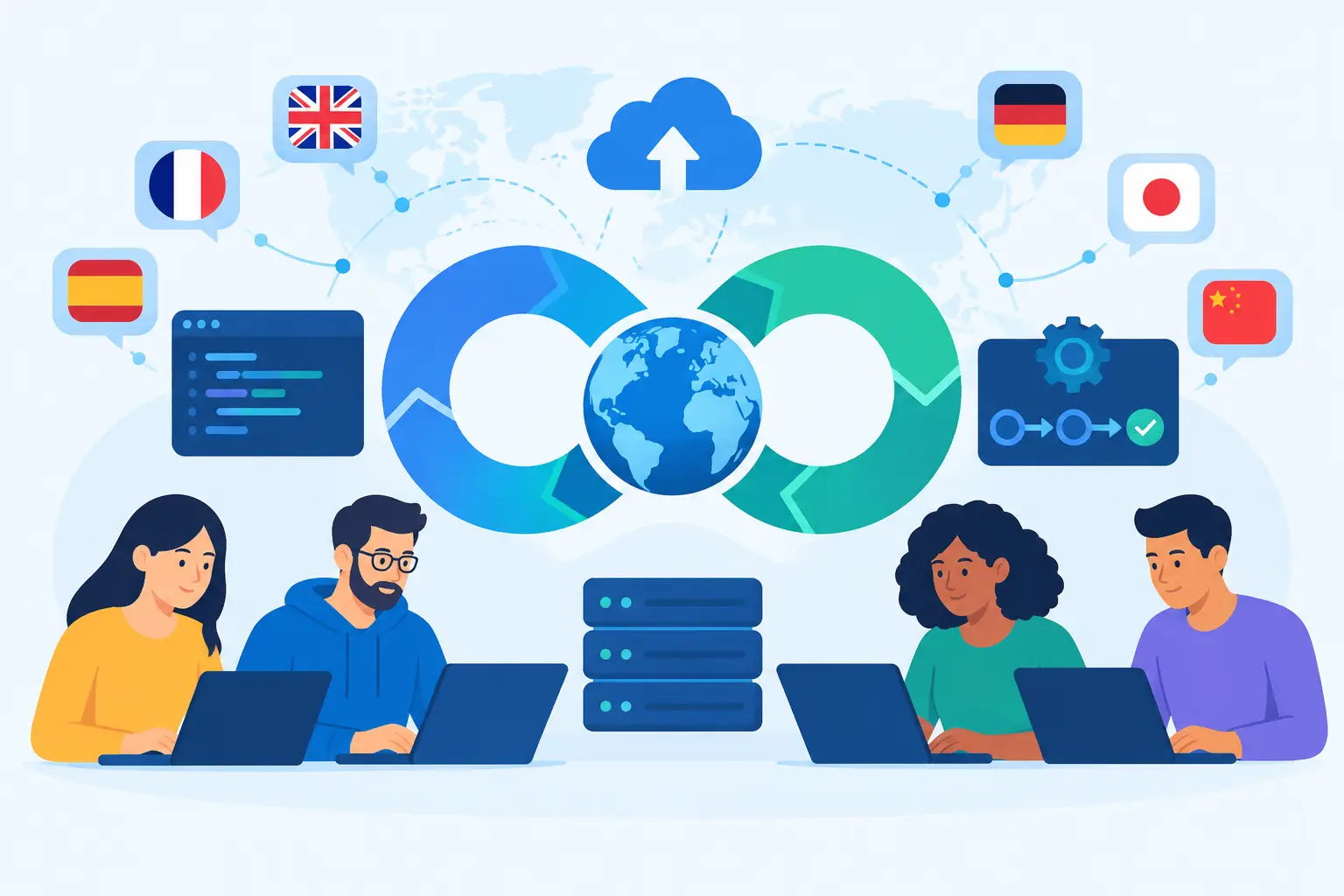
A release pipeline can compile cleanly, pass tests, and deploy on schedule while still failing customers in another language. A missing string, broken placeholder, truncated mobile label, or outdated legal document is enough to create that failure. Multilingual DevOps trends address this gap by treating localization as a production engineering concern, not a handoff that begins after development is complete.
For engineering and localization teams, the shift is practical. Translation work must be traceable to source changes, validated against the actual resource format, and available when a release candidate is built. The teams moving fastest are not merely adding machine translation to a ticket queue. They are designing localization workflows that work with repositories, build servers, quality gates, and deployment schedules.
Multilingual DevOps Trends Moving Into Production
Continuous localization replaces batch exports
The most visible change is the decline of the large, late-stage export. In a batch process, developers freeze strings, export files, send them for translation, wait for delivery, then import the results before a release. This can work for a stable product with infrequent updates. It becomes expensive when web applications, mobile apps, documentation, and backend services change continuously.
Continuous localization connects source scanning and translation updates to the development cadence. When a developer adds or changes a resource, the localization system detects the change, preserves existing translations where possible, and identifies only the content that requires attention. Translators receive smaller, more frequent workloads instead of a high-risk package near the end of a release.
The trade-off is operational discipline. Teams need stable resource identifiers, clear ownership of source files, and a policy for when changed source text invalidates a translation. Without those controls, continuous flow can create noise rather than speed. For products with quarterly releases and heavily reviewed regulated content, scheduled translation cycles may still be appropriate. The useful model is not continuous localization at any cost, but localization synchronized to the actual release model.
Localization checks become pipeline quality gates
Build pipelines increasingly validate more than compilation and unit tests. They can also verify whether localized resource files are complete, structurally valid, and safe to package. This is especially relevant for formats where a manual edit can break syntax or runtime behavior, including RESX, JSON, XML, YAML, PO, XLIFF, Android XML, iOS strings, and database-backed content.
A meaningful localization quality gate checks conditions that affect the shipped product. Examples include missing translations, duplicate keys, invalid markup, inconsistent placeholders, broken accelerators, mismatched plural forms, and values that exceed defined length limits. These checks should produce actionable build output: the file, key, locale, and error type. A vague statement that a language package failed is not enough for a developer to fix the issue efficiently.
Not every warning should block deployment. A missing translation for an unreleased feature may be acceptable in a feature branch, while the same issue should fail a production build. Mature pipelines classify errors by severity and apply rules by branch, product, and target locale. This keeps quality controls credible instead of encouraging teams to bypass them.
Source-code control remains a security boundary
Cloud-based translation workflows can be convenient, but convenience does not remove source-code, data residency, or customer confidentiality requirements. One of the stronger multilingual DevOps trends is keeping localization processing close to the development environment. Local scanning and build-server execution allow teams to extract translatable content and generate target files without granting external systems broad repository access.
This matters beyond source code. Resource files can contain product roadmaps, internal feature names, personally identifiable data, connection strings that should never have been localized, and regulated terminology. A secure workflow needs explicit inclusion and exclusion rules, protected credentials, auditability, and separation between source assets and translation packages.
The right architecture depends on the organization. A public SaaS product may accept hosted workflow components for selected files. A financial, government, healthcare, or enterprise software vendor may require all processing to run inside its controlled network. In either case, security should be designed into the pipeline rather than added after teams have distributed source files across email attachments and unmanaged folders.
Translation Context Is Becoming Build Data
Text without context remains one of the main causes of translation defects. The word “Open” can be a button, a menu command, a status, or an adjective. A string with `{0}` may display a user name, a date, or a count. Translators can make sound linguistic decisions only when they understand where the content appears and what technical constraints apply.
DevOps-oriented localization systems increasingly package context alongside the source text. That can include resource comments, file paths, keys, character limits, screenshots, UI coordinates, plural rules, markup restrictions, and references to related strings. Visual editors are particularly valuable for desktop, web, and mobile interfaces because they expose layout and neighboring controls that are absent from a spreadsheet.
This approach changes how teams define a translatable resource. The source string is no longer the entire unit of work. The unit includes metadata needed to translate, validate, and deploy that string correctly. Development teams benefit because fewer translation questions return to engineering late in the cycle. Localization teams benefit because quality is based on evidence rather than guesses.
Translation memory and terminology support release consistency
Machine translation is now a normal productivity component, particularly for high-volume updates and long-tail locales. Its value depends on how it is governed. Raw machine output may be acceptable for internal dashboards or low-risk content, but customer-facing software requires terminology, context, review requirements, and quality checks.
Translation memory reduces repeated work by reusing approved translations for identical and similar segments. A terminology database establishes approved product names, UI terms, abbreviations, and prohibited translations. Together, these assets provide consistency that generic machine translation cannot infer from a single string.
The DevOps implication is that linguistic assets need versioning and controlled updates just like code assets. When a product term changes, teams should know which translations are affected and whether existing releases require a correction. When a translation is approved, it should be reusable in the next build without relying on an individual translator’s inbox or a disconnected vendor portal.
Format Intelligence Matters More Than Generic Connectors
Localization automation is only as reliable as its understanding of the files it processes. A connector that can move text between systems is not necessarily able to preserve format-specific behavior. Software products often combine resource formats across desktop applications, web front ends, mobile clients, documentation, installers, databases, and structured configuration files.
Format-aware processing identifies translatable fields while protecting code, placeholders, tags, binary data, and metadata. It can recognize that an HTML value requires tag preservation, that a .NET RESX file uses resource keys and comments, or that an Android layout has UI properties that affect visual validation. It can also generate deployable localized outputs instead of leaving teams to manually reconstruct files after translation.
This is where a unified technical localization platform such as Soluling can reduce workflow fragmentation. Broad format support, translation memory, terminology, visual context, validation, and build automation are most useful when they operate on the same project data. Teams avoid the common failure mode of using one system for extraction, another for translation, a third for QA, and scripts of uncertain ownership for reintegration.
What Teams Should Change First
The first improvement is usually visibility. Map the path from a source-string change to a localized artifact in the release package. Identify where files are copied manually, where context is lost, where translations wait for a batch, and where no one verifies the final output. Those points reveal the highest-value automation opportunities.
Next, establish a minimum localization contract for every supported format. Define stable identifiers, required comments or context fields, placeholder rules, locale fallback behavior, and validation thresholds. The contract should be understandable to both developers and localization specialists. If it exists only as tribal knowledge, it will fail during team changes and release pressure.
Then automate one product path completely before expanding across the portfolio. For example, scan a web application's JSON resources, create translation packages, apply translation memory and terminology, validate placeholders and completion, generate locale files, and publish them through the existing build process. A narrow implementation proves the operational model and exposes exceptions without forcing a risky organization-wide migration.
The goal is not to make every translation decision automatic. It is to remove the avoidable delays and preventable defects around translation work. When localization artifacts are built, checked, and released with the same discipline as the application, global expansion stops being a separate project that interrupts delivery. It becomes a capability the delivery system can support release after release.